
Reading for the Seventh Sunday after Epiphany:
When he returned to Capernaum after some days, it was reported that he was at home. And many were gathered together, so that there was so longer room for them, not even about the door; and he was preaching the word to them. And they came, bringing to him a paralytic carried by four men. And when they could not get near him because of the crowd, they removed the roof above him; and when they had made an opening, they let down the pallet on which the paralytic lay. And when Jesus saw their faith, he said to the paralytic, “My son, your sins are forgiven.”
Now some of the scribes were sitting there, questioning in their hearts, “Why does this man speak thus? It is blasphemy! Who can forgive sins but God alone?” And immediately Jesus, perceiving in his spirit that they thus questioned within themselves, said to them, “Why do you question thus in your hearts? Which is easier, to say to the paralytic, ‘Your sins are forgiven,’ or to say ‘Rise, take up your pallet and walk.’ But that you know that the Son of Humanity as authority on earth to forgive sins” — he said to the paralytic — “I say to you, rise, take up your pallet ad go home.” And he rose, and immediately took up the pallet and went out before them all; so that they were all amazed and glorified God saying, “We never saw anything like this!”
(Mark 2:1-12)
This was the Scripture lesson that was read in the church service many of us from MCC attended on Sunday, February 19, 2006, in Porto Alegre, Brazil. It was about half way through our World Council of Churches experience. We had spent the week handing out MCC literature and running out of MCC literature in three languages at our booth, which had been handsomely decorated in purple by Paul Fairley and Diane Fisher, complete with the MCC logo and draped in beautiful fabric. The MCC booth in the Mutirao (Portuguese for “community gathering place,”) was our gathering place at the Pontifical University which was hosting nearly 5000 WCC delegates and visitors from all over the planet — participants from over 127 countries and 384 denominations.
On Friday of the Assembly, we had listened to President Lula of Brazil, as he praised the work of the World Council of Churches and courageous Christians in Brazil who had managed to sneak out of the country top secret documents that implicated the previous government in illegal schemes, including torture and repression and fraud. While the President spoke, communists protested just outside the hall, and supporters danced and rallied.
It was democracy at work! There were huge crowds, and at one point MCC’s organizer in Brazil, Gelson Piber, grabbed me and said, “Mira! (Look up)!” and right above us, on the stairway was the President of Brazil. Gelson, who is a sometime critic of President Lula, was beaming with Brazilian pride at the evidence of all this renewed and thrilling democracy. There had been worship services, intense conversations on Human Sexuality (a first for the WCC) and hundreds of conversations with attendees, some of whom had walked past MCC’s booth five or even ten times before stopping! And the great moment of coming together was when the Dalits of India (the untouchable people, mostly Christians) organized a mid-day parade through the conference hall. When our MCC folks saw the Palestinian Christian Youth group join them, they joined in too – the queers, the young Palestinian Christians and the Dalits — what a parade! Jesus would have loved it!
A group from Brasilia, who had read all about us on the MCC website and who have been worshiping together for a year, drove two days to meet us at the Assembly. It felt so New Testament! The very first day they arrived, they were so excited to meet “their” Elder Darlene Garner and the new Moderator of MCC that they were teary and too excited to even try to speak English! They volunteered immediately to staff the booth, which they did for the remainder of the Assembly. This plunged them into MCC with new intensity and really helped the WCC to know “We are everywhere.”
Eventually we also met a young theologian from Porto Alegre and members of his group, who were also very drawn to MCC. We quickly became a community, along with our friends from the European Forum for LGBT’s. WCC staff, especially music and worship staff, also became friends, and they volunteered to provide the music for our service! We also made several friends in the Ecumenical Disabilities Forum, particularly a young man in a wheelchair from Lebanon, who urged us to “come and start an MCC in Beirut!”
But back to Sunday… Sunday was the day WCC Assembly guests were to find our way to local Brazilian churches, who were getting ready for us. Because our own Araceli Ezzati is also a Methodist pastor in Uruguay, we were going to go with her to a Methodist Church.
But, after a very long, exhausting Saturday, we found, slipped under our hotel room doors, an invitation to a Lutheran Church just across the street! The conference planners took great pains to point out that they had placed MCCer’s with others they thought would be “friendly,” namely the Canadians! We were housed with folks from the United Church of Canada, the Anglican Church of Canada, Canadian Lutherans and other LGBT folks from Europe. All of us in our hotel decided we would go to the Lutheran Church in the morning.
So, taking the path of least resistance, we walked across the street to the little Lutheran Church. Blonde Brazilians! Brazilians of all colors. Elderly folks and young families.
As it turns out, this was a church planted by the Missouri Synod Lutheran Church, USA. Their denomination does not practice an open communion. They did not even have communion with the other Lutherans in Brazil, but we did not know this at the time! We had also heard a rumor that they did not ordain women. So all of us women clergy wore our collars as a quiet witness.
The church was quaint German Lutheran architecture, a sweet building that would barely hold 150 people. There were more than 100 visitors that morning. It is impossible to convey all that happened, or that we felt, but I will summarize:
1) We were warmly greeted, by church members, in English (most Brazilians do not speak English), and handed a bulletin that contained the entire liturgy and all the songs in English, which was the primary language spoken at the Assembly. Darlene and I did our best to sing in Portuguese!
2) We were welcomed from the front of the church by a translator, who explained that for the regular members the words would be in Portuguese on their PowerPoint in the front.
3) There were not enough seats, so about half or more of the members stood outside or in the narthex throughout the service, leaving seats for us to find.
4) The sermon was from today’s text, found in the Gospel of Mark, Chapter 2. The pastor preached in Portuguese, ably translated for those us who were visitors. The young pastor beamed as he spoke about sin and forgiveness. (He was a Lutheran, after all!) He told a touching story about a dearly beloved member who was at death’s door. He did not preach to us, specifically, he preached to all of us together. We were invited into their congregation’s reality, and to hear the gospel as a gathered community that day.
5) At communion time, the pastor made an emotional and special announcement – that on this day they would serve an open communion. He took some time to express to us what that meant, but basically, we were to self-select as “believers in Christ,” with no litmus test. We had no idea at the time, what an incredible stretch this was for that church, who had never even dared share communion with the Lutheran church down the street! But here we were – from every continent, and many denominations, straight, LGBT and everything else – sharing a common loaf and cup.
6) Before the service ended, they welcomed us again and invited people to bring greetings. The Canadians were very emotional in their thanks – some of their denominations brought gifts to give. The lesbian pastor of a German Lutheran Church and her partner from Norway greeted them on behalf of the LGBT community in Europe and for all of us at the Assembly. I could feel her heart pounding as she spoke, and my heart was pounding with her. The translator had no difficultly translating. No one died from her greeting – though I did think the woman next to me breathed in a little sharply at that point. She recovered nicely, and smiled no less sweetly at me.
7) As we left, the pastor greeted each of us warmly, and those of us from MCC and the European LGBT group were photographed. A lot. Especially by young people at the church! It was a big day for this little church in the southernmost city in Brazil.
For me, this experience was a parable. I thought of how easy it is for us to take an open communion for granted, among other things. I thought of what the equivalent of that Lutheran service would be in our local MCC churches – what would it mean to print our bulletins in a language most of us did not speak, just to make newcomers feel welcome and at ease and not lost in the service?
What would be the moral equivalent of that in your church? Who of us would be willing to stand outside, offering others our seat, perhaps lifting them through the roof? What would it mean to preach in a way that met the needs of our “regulars” but also spoke to those who were new or very different? How might we not take our open communion for granted, but find new ways to make it fresh and inviting, and full of Jesus’ style of innovation and imagination. What might be our equivalent “leap of faith and inclusion” that they took on our behalf that day?
And are we willing to let first timers voice their identity, needs and thanksgiving? Risky business!
A few days later, at morning worship, I just “happened” to sit next to a man from India. He was connected with a seminary, and after I found out about him, he asked where I was from, and what church. I told him about MCC’s ministry. And then he asked if we had any churches in India. When I told him no, his eyes filled with tears, and he said, “May I have your business card for my daughter? She will be in touch with you, I promise.” We shared a song book and smiled deeply at each other the rest of the service. I am holding his promise in my heart — will you hold it with me? — for our LGBT sisters and brothers in India?
I was deeply impressed with the generosity and genuine holiness I felt in that little Lutheran church — a church that does not ordain women and normally does not open its communion table. I was touched and humbled by those lay members who gathered around the grieving family of a dying man, as would be done in every good church everywhere. Even in the midst of great assemblies, life and death still go on just across the street.
Later in the week, we would hear sounds coming, every night, from that little church — a band practicing, a choir singing, a mid-week service. The sounds were all of joy and praise and gospel power. I am sure they will talk for a long time about the strangers in their midst who worshiped with them, brought them gifts, let them take pictures, challenged them, and gave them an opportunity to make history for themselves. Can they ever go back to a “closed” communion without remembering us? I hope not.
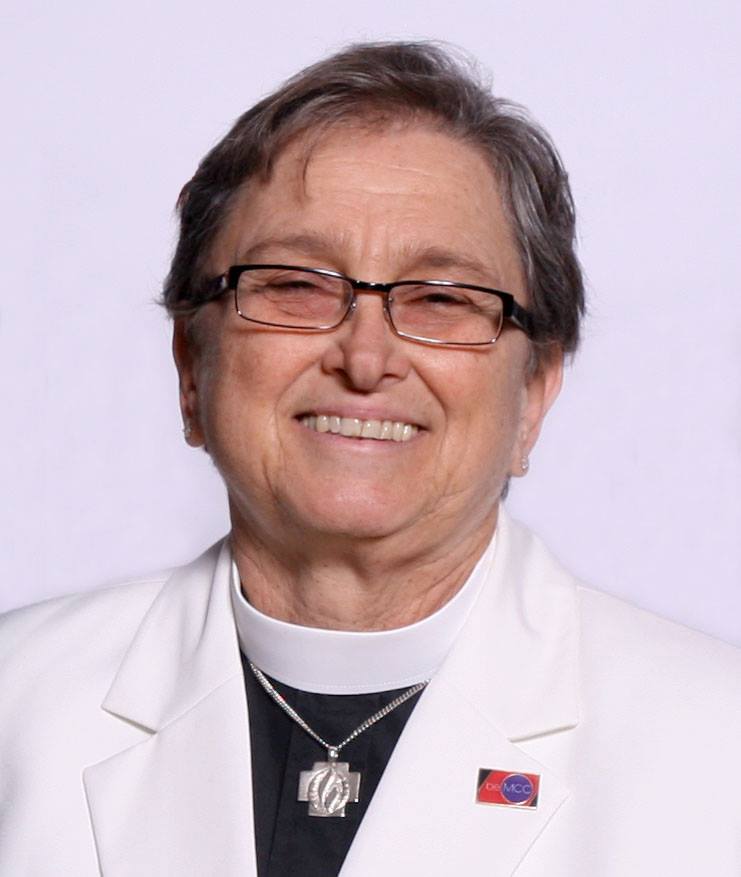
Former Moderator (global leader) of Metropolitan Community Churches (MCC), Rev. Elder Dr. Nancy Wilson was elected to that position in 2005, following the retirement of the founder of MCC, Rev. Elder Troy Perry. She earned a B.A. from Allegheny College, an M.Div. from SS. Cyril and Methodius Seminary, and a D.Min. from Episcopal Divinity School (EDS). She received an honorary Doctor of Divinity degree from EDS in 2016.
In 2011, President Barack Obama appointed Rev. Wilson to the President’s Advisory Council on Faith-Based and Neighborhood Partnerships. Their work culminated in a report of recommendations to the President: “Building Partnerships to Eradicate Modern-Day Slavery.” Following President Obama’s re-election in 2013, Rev. Wilson gave a Scripture reading at the Inaugural Prayer Service at the National Cathedral in Washington, D.C., and was the first openly gay clergy member to participate.
Her published works include: “Trust is a Queer Thing,” in Stars Shine Upon the Road of Hope (繁星照耀希望路); “A Queer Theology of Sexuality,” in On the Way of Acceptance: Christianity and Queer Community; Outing the Bible: Queer Folks, God, Jesus, and the Christian Scriptures; Outing the Church: 40 Years in the Queer Christian Movement; Nossa Tribo: Gays, Deus, Jesus e a Bíblia; Our Tribe: Queer Folks, God, Jesus and the Bible; and with Fr. Malcolm Boyd, Amazing Grace. Her prayers and poems are included in Race and Prayer, edited by Malcolm Boyd and Chester Talton. Her most recent publication is I Love to Tell The Story, 100+ Stories of Justice, Inclusion and Hope.