
… I talk about my life anyway because if, on the one hand, hardly anything could be less important, on the other hand, hardly anything could be more important. My story is important not because it is mine, God knows, but because if I tell it anything like right, the chances are you will recognize that in many ways it is also yours. Maybe nothing is more important than that we keep track, you and I, of these stories of who we are and where we have come from and the people we have met along the way because it is precisely through these stories in all their particularity, as I have long believed and often said, that God makes himself known to each of us most powerfully and personally. (Frederick Buechner)
I’m going to make a sweeping, general, condemnation. Most people writing about growing up gay are not telling it anything like right.
Yes, that’s unfair. I say it ironically because I wanted to open with that Buechner quote as an apology for why I’m writing some of my personal stories. When I think of the reasons why I really want to write about my life, however, it is because I don’t recognize myself in the, admittedly limited, memoirs by other gay men that I’ve read. That’s not entirely true, of course. I recall reading a bit in Bruce Bawer’s A Place at the Table wherein he describes the mental gymnastics of one who is gay and trying to convince oneself one is not, and indeed could not be, gay. I laughed out loud in recognition. Nonetheless, my story is different from Bawer’s. It’s different enough to make me say, yes, but. Yes, but I didn’t go through that experience until I was at least 20. Yes, but my life took place in a distinctly rural, distinctly German, Lutheran setting, which adds it’s own flavor, it’s own peculiarity. Yes, but I want to tell it the way it happened to me.
That last line is probably the most true. E.B. White wrote in his foreword to a collection of his essays: “Only a person who is congenitally self-centered has the effrontery and the stamina to write essays.” Writers of memoirs are whatever is more serious than “congenitally.”
So, I’m sitting here in the middle of the night capturing a snatch of inspiration to explain myself and the best I can do is this. Yes, Frederick, if I tell it anything like right, you’ll recognize that my story is also yours, but even more, if I do it anything like right, I will awaken in you a story you haven’t thought about in some time, some clouded memory that is stored away in a closet behind that box with the zip codes of all the places you’ve lived before and will never live again. I want to help you pull out that little box of memory and place it before the zip codes (really, why are those so accessible in our memory closets?) and shine some light on it. Your memory is what makes you You. As difficult as it is to understand who we are, I’m hoping that by sorting through my own boxes and maybe coming to a better understanding of who I am, you might also come to a better understanding of who you are. Caveat: This won’t be painless, it won’t be all warm fuzzies and angelic choirs. But it might be revelation all the same.
So much for apologies. Over the next, oh, year or so, I hope to publish in Whosoever some of my memories and what they mean to me as I slide ever so gracefully into middle age. I’m going over these memories because, truth be told, I’m not sure I was completely present for them the first time. I want to be clear on two things for this writing exercise. First, I had a pretty darn happy childhood. Really, I’m not just saying that. I grew up on a farm and ranch with about 300 acres of playground and animals. It was an incredibly safe childhood, far away from random crime and mean people. My parents were your basic good, German, Lutheran farm folk with an incredible amount of smarts, especially when I think about how little schooling they had, and however else my six older siblings remember this time and place (and I suspect some had different perspectives since I know at least a couple couldn’t wait to get away from the farm) I look back on it as just about the best anyone could hope for. The second thing, however, is that I spent the first 20-some-odd years of my life in numbness, had a brief 3 or 4 years of excruciating feeling, and then spent another 6 or so enjoying the numbness again. That is to say, I lived very much afraid of my own sexuality and in pursuit of recognition for being a good boy. This desire to be “good” meant that I had to cultivate that numbness very nearly to a fine art because the feelings I felt were not those of a “good boy.” It’s only in my thirties that I have come to accept and embrace my sexuality and actually allow myself to feel that part of me unashamedly and that feeling has opened all kinds of other feelings. So looking back at my childhood is a little like experiencing it one more time, with feeling.
And for the purpose of this initial series, I’m sticking to my childhood, roughly between the the time I was born in 1963 through the summer of 1978, when my youngest sibling graduated from high school, left home, and left me to be the only child on the farm. That’s fifteen years through which to ramble non-chronologically, loosely thematically. Let me jump in right away with some of my earliest memories.
The Earliest Sign That I Just Might be Gay
I own a memory that makes so much more sense to me now that I accept my sexuality and it affirms for me that sexuality is set at an early age. Back when I was trying to be straight, I had a real hard time explaining this one away. We were watching some television program at home. I don’t know what age I was, but I’m pretty sure I was under school age. Four? Five? Anyway, it was a variety show, probably Lawrence Welk from what I recall of the time of day (late afternoon/early evening — too early for Carol Burnett or some of the other variety shows we watched regularly) and it had about 10 dancers in this musical number, equal number men and women. The women were dressed in hoop skirts, all frills and bonnets and parasols, and the men were dressed in tux pants and I think maybe vests with tux shirts. I really don’t recall their upper bodies so much, so they may have had on jackets.
I don’t think they wore jackets, however, because that would have obscured what I do clearly remember, which would be their butts. Specifically, I very clearly recall a moment in this number where all the women were posed upstage right, in a line, looking coquettish and shy, and the men were in a diagonal line from the women to downstage left, down on one knee, backs partially to the audience as they struck a pose as if they were doing a mass marriage proposal. Their downstage knee was up, the upstage knee on the stage.
I have this very distinct memory of those little, male, dancer butts in those little, tight, black pants, loved by the camera. Even more, I have this distinct memory of turning to one of my sisters, who must have been home for the day because my sisters were all moved out by the time I was old enough to have memories of them, and commenting on the pose. I struggled for the words to express how I felt about those butts and the best I could do was, “I think that looks good when the men are like that,” and I demonstrated the pose. It seems like she wasn’t really paying attention to the television and even less to me. I have no idea what she said in reply, although I remember she made a reply. I wonder that she didn’t look at the screen, look at me, and mutter, “fag.” Now, in a world wherein people are allowed to think about sexuality from their earliest powers of such thought, would I have named that moment as the moment when I knew I was gay? Maybe not and that’s the mystery of memory to me. I now look back on that moment and recognize the homo-erotic content, but at the time, I just knew that I liked what I saw. It could just as well have been the moment when I realized I wanted to be a dancer, a realization I made about the same time I accepted my sexuality. Fortunately, you can come out at 30. Unfortunately, you can’t run off and audition for Mark Morris at 30.
Numbness. It has a cost. But I digress.
A couple of years ago, I asked my late friend, Bill Williams, about his earliest memories of finding girls attractive. He grinned. We had both heard the sarcastic comment made, “When did you realize you were heterosexual?” but I was the first person to ask him and really mean for him to think about it. It’s even more difficult because, culturally, we assume boys have only one thought about girls until around the age of 13: “Ew, yuck. Girl germs!” But Bill, good friend that he was, thought about it and finally said, “You know, there was this girl when I was maybe in kindergarten. I remember looking at her and thinking she was the prettiest thing I’d ever seen.”
Now, Bill obviously wasn’t chasing skirts that early and I suspect that he didn’t really get going on this girl thing until the hormones of adolescence kicked in, but he seemed pleased that I fished this memory out of his memory closet. It helped him not only understand how early his sexuality was set, it helped him understand that my story about the dancers’ butts didn’t make me a leering man-chaser by the time I started first grade. I no more knew why I liked the guys’ behinds in that musical number than Bill knew why he found that girl so pretty. Furthermore, neither of us had any idea of how to act on or even name those feelings. But they were there and our adult experience could be placed on those feelings and we could finally name them and own them in a new way.
There is this ironic twist in my pre-school days. I had lots of girlfriends, it seems. At least they let me call them that and they called me their boyfriend. I must have seemed like some little 5 year old, chubby Don Juan with these teen-aged girls as my girlfriends. I don’t even remember who they all were. I recall one distinctly, a neighbor girl (and in my community, a neighbor was anyone within a five mile radius) and probably her older sister at some point. We made crayon and construction paper cards for each other. It seems like I had named a cousin or two my girlfriend, too. In fact there was one cousin who was actually about my age, so my girlfriends had a range from about 5 to 18. It was all very innocent and silly, but it seemed to make them pleased and I was nothing if not a little pleaser as a child. Just to add an extra ironic twist to it, I recall one time when I was at this neighbor girl’s house and we were all excited because an Elvis Presley movie was going to be on television that night. As I think on that night, I was just as excited to see Elvis as she was.
Even my heterosexual pretend games had a homo-erotic aspect to it.
The Earliest Clue That God Was Going to be Prominent in My Life.
First, I’m going differentiate between God and the church. The church was, indeed, a given in my life. We weren’t every Sunday sort of church-goers, but we were regular, making it at least a couple of times each month. Sunday school wasn’t pressed upon us, but that seemed to be more important as we were sure to at least make it to Sunday school most Sundays. I’ll talk about me and church and Sunday school later and in greater depth, because it was, indeed a force in my life. God will also play a more in-depth role as I go along, too, but I want to relate this story first. I had my first mystical experience in the backyard. I may have been in school by this point, but just barely, no more than first grade. I was laying on my back and thinking about something they’d said in Sunday shool or church or somewhere. It was said that God wasn’t some old man with a grey beard sitting up in heaven, but that God was a spirit who was everywhere. Even though we couldn’t see God, God was there.
This now seems like a pretty abstract thought to be pushing on a kid so young, but I was apparently up to the challenge. Lying in the grass on a warm, sunny day, watching patches of clouds go by, I contemplated this God who was not a person but a spirit and I recall getting this most particular feeling. I suddenly Knew, not just thought but Knew that God was up there in the sky, among those few clouds, stretching across the blueness in between and God was in the grass beside me, on both sides and even under me and above me. Not above me like way up in the clouds above me, but directly above me, on me. God was in the branches of the pecan tree just to the east of me and in the shade of the elm tree just to the west of me. When I read St. Paul write about not knowing how long he was caught up into heaven, I recognize this moment because I don’t know how long it lasted or how it stopped. I don’t know when I got up and went back to being a little boy drawing pictures and playing in dirt. What I do know is that for a moment, God became imminently real, invisible but tangible because God had touched me.
I had been touched by God.
I don’t think I told anyone about that experience. I was well into my twenties before I had a name for it — mystical experience. (Lutherans didn’t use such words back then and still are a little skittish about them.) I don’t generally think of myself as having a Conversion Experience because it feels like I’ve always believed and I’ve really come to think of my lifea as onle long conversion experience because I still feel like I’m becoming a Christian, that I’m not quite one yet. If a conversion is the time when you believe on your own, not just because the church, your parents or the Bible told you so, then that was it, but really it was just the beginning.
I start this series with these two stories because they are early memories, although not the absolute earliest, and they deal with two items that are central to my life and identity and are the two angels with whom I have wrestled most fiercely: Sexuality and God.
If I told the stories anything like right, they not only revealed my experience, but illuminated yours. I hope they spark some early memory for you, some moment when God touched you, even if you didn’t recognize it for what it was until just now. Maybe some point in your history when you clearly felt attraction to the gender to which you are now attracted, even if you didn’t (couldn’t) recognize it as sexual attraction at the time.
Not every story I tell will be so centered on sexuality or God, but these are the centers, one of which I did my best to be numb to, the other that I actively followed and pursued my whole life. For the purpose of this series, everything, at least indirectly, revolves around these twin suns.
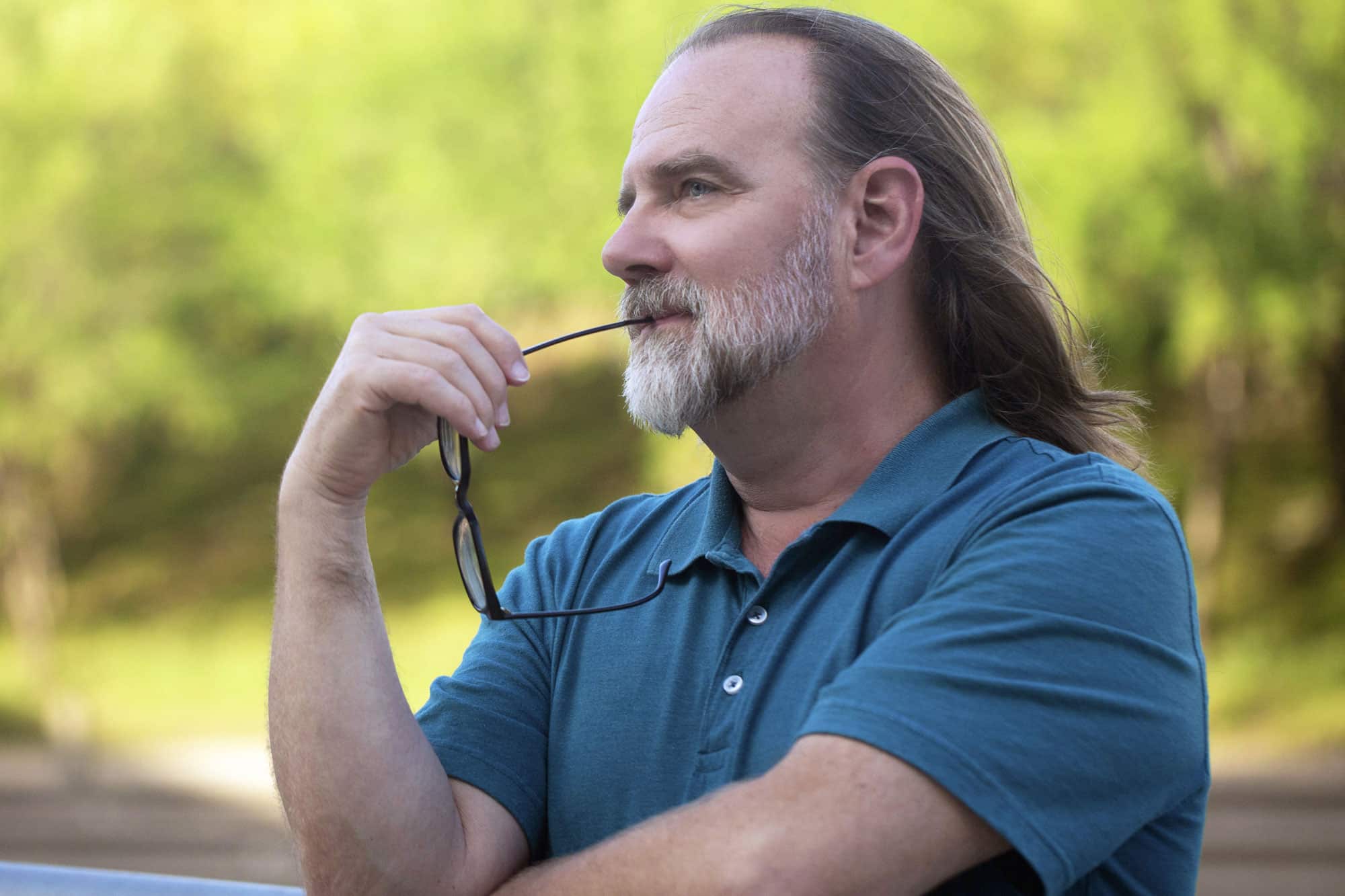
A writer in Houston, Texas, whose work has appeared in a number of small press journals and anthologies, Neil Ellis Orts occasionally writes articles on the arts. His novella, Cary and John, is available from Wipf & Stock Publishers.