
I’ve written about some early clues that I should have picked up on, telling me I’m gay, but there were more. While I had some typical boy interests, such as comics and adventure TV shows, I felt no shame in liking Wonder Woman and the Bionic Woman as much as Superman or the Six Million Dollar Man. In fact, I liked them better. I identified with them more on a personal level. Now, before anyone starts trying to picture me in “your satin tights, fighting for your rights,” I should point out that I never had any gender confusion out of this. I never wanted to be or even dress up like a woman — I am gay, not transgender — but I somehow identified with their marginalized status. It was the ’70s and there was plenty of talk about women being equal and that just seemed so right to me. Women super-heroes, then, seemed to need me in their corner, their advocate that they had just as cool adventures as the guys did.
But the guys . . . I did like them but while my brother seemed very interested in Lynda Carter’s chest, I was much more interested in Lee Majors’. Had anyone pinned me down about my interest in those episodes of the Six Million Dollar Man wherein he ran about (in slo-mo, of course) completely shirtless — I recall one of the Bigfoot episodes (I think) when he ran around shirtless IN THE RAIN! — I wouldn’t have had an answer for why I was so riveted to the screen. I think my over-developed sense of piety or equality played in here, too. Somehow, I took it as moral fortitude that I was able to watch Wonder Woman without lusting after her eagle, but it just seemed right that if the women were exposing their cleavage, then the men should be exposing their pecs.
What a tangled web of emotion I feel even now, trying to sort through it all. Ah, but Superman . . . Well, I admit I was more of a Batman fan growing up. Yes, there was some of that stereotypical “you could grow up to be Batman, but you had to be born on Krypton to be Superman” sort of reasoning behind liking Bats better, but I can also pinpoint when I first consciously chose Bruce Wayne over Clark Kent.
In the ’70s, DC Comics, the publishers of Superman, Batman, Wonder Woman, and a whole slew of other heroes, published a series of over-sized, tabloid comics. One was a collection of stories by (primarily) Denny O’Neil and Neal Adams which introduced the first new major villain in Batman’s rogue gallery since . . .well I don’t know when. Ra’s Al Ghul was this new villain’s name and he was exotic and mysterious. But that’s not what made me like Batman better than Superman.
No, Neal Adams drew a swordfight scene between Ra’s and Bats and they were both shirtless. Batman had a hairy chest. The rest was history.
Neal Adams made me fall in love with Batman, but it was Mike Grell who made me love the Legion of Super-Heroes, Green Lantern, and his own creation, The Warlord. As with the reason I chose Batman as my favorite hero (hairy chest — and you must remember that there was a time that shirtless men in the comics had neither hair nor nipples, so for Adams to give them both to Batman was quite a turning point in homoeroticism and the comics!), Mike Grell became my favorite artist because I liked the way he drew abs. Of course, I couldn’t have pinpointed it back then, but when I think of Grell’s work, I think of the torso on his men. I was so very queer. In retrospect, of course.
Now, of course, there’s no getting around the obvious with super-heroes and their chosen uniforms. It’s hard to ignore that they all wear tights. While neither Adams nor Grell were very generous to their heroes in the way they drew their, um, lower abdomen, I do recall enjoying certain characters precisely because of how they wore their tights. Captain Comet comes to mind. He was a minor character, really, first having a run in Strange Adventures during the ’50s, he was resurrected in the ’70s as the foil for the Secret Society of Super-Villains. He wore white shorts over red tights. In his ’70s incarnation, the shorts had two lightning bolts on the front which zig-zagged from each hipbone to the inseam. What’s not to like?
Rich Buckler was the main artist for the early issues of the Secret Society of Super-Villains, and he did well with those little white shorts, but he was generous no matter what the Captain was wearing. I distinctly recall a drawing of the Captain, in his secret identity, Adam Blake, walking down the steps of a brownstone apartment. Captain Comet did okay in jeans, too.
A lot of this is embarrassing, of course, on many levels. Not only was I lusting after comics characters, I didn’t even realize that I was lusting after these paper creations. All the while, I piously chided my male peers for how they looked at Farrah Fawcett’s poster. “Embarrassing” doesn’t even cover it.
Growing up a gay farm boy does have some interesting implications for the adult erotic life. I didn’t realize one until I was sitting in a movie theater three or four years ago. I don’t recall the name of the film, but it was a World War II setting and at the beginning of it, there was a scene of soldiers on the beach. All these soldiers where shirtless in the sun, but they obviously usually had on short sleeve shirts. Their necks and forearms were all bronze, but their upper arms and chest were bright white.
The classic “farmer’s tan.”
Seeing those men in that movie took me back in time to unconscious moments of attraction as a youngster. There are very few men that I can name who I recall being attracted to specifically, but I found these movie men very erotic, precisely because they reminded me of men I knew while growing up. This made and makes me wonder if who we grow up around, and our experiences with same, shapes our adult erotic attractions. I don’t mean just for gay men, but also for lesbians and straight folks, too. I wonder if we find the familiar attractive if we had good associations with them as a child and if we seek out the unfamiliar (even exotic) if we had bad experiences. Surely it’s not so simple as all that, sexuality and attraction seldom is. Still, in my list of things I find attractive in a man, a “farmer’s tan” would never have come up until I saw that movie.
I shouldn’t make it sound like my childhood was all misinterpreted homoerotic feelings. There’s a lot I share in common with straight farm boys, too, but even there it’s hit and miss.
There are any number of chores I probably shared in common with most farm boys of my community. I hauled hay in the summer time. I fed pigs and chickens, took part in butchering both. I helped in the vegetable garden and chopped wood in the winter. In my current circle of friends, I’ve recently had to explain the task of rendering lard. Even among my high school friends, only a few might have done it, but it wasn’t unheard of. By the ’70s, milking cows by hand was a little unusual for most farms since most families had taken to buying their milk, but we had fresh milk, cream, butter, and cheese. Even if my peers didn’t know of these from their own homes, they may have known of it from their grandparents. So, in summary, there’s a lot I did growing up that a lot of the straight boys around me did as well.
Still there were idiosyncrasies, but not really due to any stereotypical traits attributable to my sexuality. My parents were older when I was born, indeed as old as some of my peers’ grandparents. I graduated with a nephew, in case I need to hammer in the point. Besides having older parents, I also had a bevy of older siblings, most significantly older. While not all of them came home to help at hog butchering time, enough did (and they brought spouses) that I never had to learn a lot of the details of the task. Rendering the lard seemed to be a task delegated to the youngest able-bodied child and as the youngest, I stayed in that role for a lot longer than the other sibs. It sometimes bothered me — it was akin to being seated at the children’s table at Thanksgiving — but truth to tell, even if I was outside in a cold north wind, I was standing beside a roaring fire, stirring boiling fat with a wooden paddle. I was probably warmer than those in the shed where they were cutting up hams and slabs of bacon.
Things I never did learn, however, were things like plowing a field. Even though an old Ford tractor was the first vehicle I learned to drive, I never learned how to pull a plow across a terrace or sow seed. By the time I was of age to learn this, my parents had decided to stop farming themselves and began renting the fields to my mother’s cousin. The most I ever did with a tractor was pull a trailer (usually to carry hay out to the pasture for the cows in winter, bring in firewood from the woods, or move a hard won load of gravel from this one spot in our pasture to a hole in the driveway) or run the shredder. (Do urban people know what a shredder is? Just in case, it’s like a giant lawnmower that is pulled behind a tractor. You can see them beside highways sometimes, used to control the weeds along the roads, so I suppose urban road workers know what shredders are at least.)
These little things like not knowing how to plow a field or vaccinate cattle, or castrate pigs or any number of farm tasks, some obviously more gruesome than others, didn’t really bother me until after my father died. I had a small crisis of identity and I tried to find ways to learn some these things I didn’t learn from my father. This was also during the time that I was reading books with titles like Healing the Masculine Soul (it was the late ’80s and Iron John was all the rage), so I was halfway convinced that if I’d only spent more time learning about what Daddy was doing instead of spending all that time with Mama in the kitchen or at the quilting frame, I might not have been struggling with those “homosexual tendencies.”
Now, I just realize I wasn’t cut out to be a farmer, that it’s not my calling. I do wish for a garden as I find something good and significant about digging in the dirt and watching things grow from it (apartment living and potted plants don’t quite fulfill this wish). But my vocation takes me away from this, at least for the moment, maybe for always. I can only guess.
Shortly after Daddy died, I wrote a (bad) short story about a young man in college, pursuing things that took him away from his farm heritage. The ending had him lying in bed one night, on the farm, hearing a whippoorwill crying alone in the night, only to his ears he didn’t hear “whip poor will.” He heard “you’ll be back.”
These days I think that bird was a liar. But I wouldn’t want to say I indisputably know more than night birds.
And with that, I’m ending this series for now. The main reason is that I feel I’ve lost my way on it. It felt like I had a clear goal when I began, but even after looking at the earlier installments, I either didn’t have it or I no longer believe in it. At any rate, until I can find a more focused point for my memories, I think there are more important things upon which to spend my limited writing time.
All the same, I received some very nice e-mail notes from readers of this series and if my meandering down the country roads of memory were in any way helpful or entertaining, then I have more than been repaid for my labors. Thank you for your attention over the last year.
I intend to continue contributing to Whosoever, I’m just going to go back to more theological meandering.
I mean, I gotta write. And so long as Candace is publishing me . . .
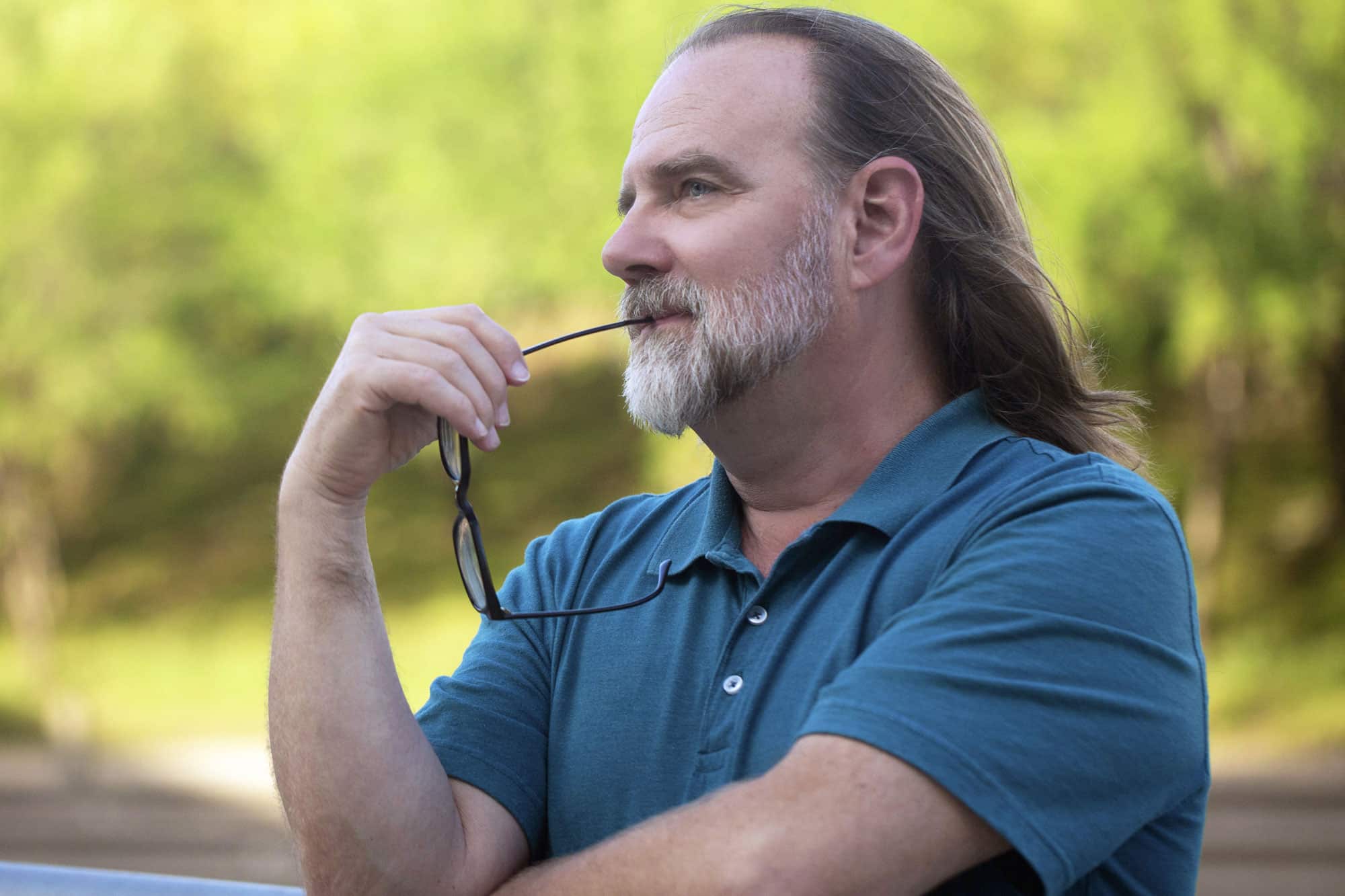
A writer in Houston, Texas, whose work has appeared in a number of small press journals and anthologies, Neil Ellis Orts occasionally writes articles on the arts. His novella, Cary and John, is available from Wipf & Stock Publishers.