
In the gospel of John there is a shift, as I see it, from how the word belief is understood and used as compared with the synoptic gospels of Mark, Matthew, and Luke.
These two contrasting uses of the word belief are:
1) Belief in or acceptance of the personhood of Jesus.
and…
2) Belief in or acceptance of the soundness of Jesus’ positions.
In the former, belief in the person – who he is – is of concern. In the latter, belief in the position – what he advocates – is of concern.
John uses the word “belief” about fifty times in his gospel. Six times as often as Matthew and nearly twice as often as all the other evangelists combined.
Compare some verses that use the word belief in the synoptic gospels with verses from John:
- Matthew 21:32: For John came to you to show you the way of righteousness, and you did not believe him, but the tax collectors and the prostitutes did. And even after you saw this, you did not repent and believe him.
- Mark 1:15: “The time has come,” he said. “The kingdom of God is near. Repent and believe the good news!”
- Luke 1:20: And now you will be silent and not able to speak until the day this happens, because you did not believe my words, which will come true at their proper time.”
- Luke 8:12: Those along the path are the ones who hear, and then the devil comes and takes away the word from their hearts, so that they may not believe and be saved.
- Luke 8:13: Those on the rock are the ones who receive the word with joy when they hear it, but they have no root. They believe for a while, but in the time of testing they fall away.
- Luke 24:25: He said to them, “How foolish you are, and how slow of heart to believe all that the prophets have spoken!
Emphasis is upon believing: the good news, my words, all that the prophets have spoken. Examine the paradigm shift in use of the word belief when reading verses on belief in John:
- John 1:31: But these are written that you may believe that Jesus is the Christ, the Son of God, and that by believing you may have life in his name.
- John 3:18: Whoever believes in him is not condemned, but whoever does not believe stands condemned already because he has not believed in the name of God’s one and only Son.
- John 6:29: Jesus answered, “The work of God is this: to believe in the one he has sent.
- John 6:36: But as I told you, you have seen me and still you do not believe.
- John 8:24: I told you that you would die in your sins; if you do not believe that I am [the one I claim to be], you will indeed die in your sins.
- John 9:35: Jesus heard that they had thrown him out, and when he found him, he said, “Do you believe in the Son of Man?”
- John 9:36: “Who is he, sir?” the man asked. “Tell me so that I may believe in him.”
- John 11:26: and whoever lives and believes in me will never die. Do you believe this?
- John 20:31: But these are written that you may believe that Jesus is the Christ, the Son of God, and that by believing you may have life in his name.
Notice how the shift is to personhood: believes in him, you may have life in his name, to believe in the one, believing you may have life in his name.
Matthew of the synoptic gospels is an action man, a “deeds” man. Below is what he thinks we should do in life and what he thinks will be the consequences of our performance or nonperformance. Here Jesus is recorded as having said:
Matthew 25:33-46 “He will put the sheep on his right and the goats on his left. Then the King will say Come, you who are blessed by my Father; take your inheritance, the kingdom prepared for you since the creation of the world. For I was hungry and you gave me something to eat, I was thirsty and you gave me something to drink, I was a stranger and you invited me in, I needed clothes and you clothed me, I was sick … …Then he will say to those on his left, `Depart from me, you who are cursed, into the eternal fire prepared for the devil and his angels. For I was hungry and you gave me nothing to eat, I was thirsty and you gave me nothing to drink… …Then they will go away to eternal punishment, but the righteous to eternal life.”
Note that Matthew’s criterion of judgment is not confession of faith in Christ. Nothing is said of grace or justification. What counts is whether one has acted with loving care for needy people.
There are other evidences in Matthew which suggest that he believes in salvation by works:
[6:1-6] “Be careful not to do your ‘acts of righteousness’ before men, to be seen by them. If you do, you will have no reward from your Father in heaven. So when you give to the needy, do not announce it with trumpets, as the hypocrites do in the synagogues and on the streets, to be honored by men. I tell you the truth, they have received their reward in full. But when you give to the needy, do not let your left hand know what your right hand is doing, so that your giving may be in secret. Then your Father, who sees what is done in secret, will reward you.” And when you pray, do not be like the hypocrites, for they love to pray standing in the synagogues and on the street corners to be seen by men. I tell you the truth, they have received their reward in full. But when you pray, go into your room, close the door and pray to your Father, who is unseen. Then your Father, who sees what is done in secret, will reward you.”
He does not have Jesus say that the reward will be in heaven, but these subsequent verses suggest that that is what he had in mind:
[6:20] But store up for yourselves treasures in heaven, where moth and rust do not destroy, and where thieves do not break in and steal.
Again Matthew is consistent when he writes what we have come to call the great commission where instead of personhood he opts for action, for performance, “…teaching them to obey…”
[28:19-20] “Therefore go and make disciples of all nations, baptizing them in the name of the Father and of the Son and of the Holy Spirit, and teaching them to obey everything I have commanded you. And surely I am with you always, to the very end of the age.”
By the time the gospel of John was written, some ten years after the last synoptic gospel, their may have been indeed a paradigm shift in the word belief from the mere acceptance of the soundness of Jesus’ positions to the acceptance of his personhood; from more of a concern with what he advocated to more of a concern with who this Jesus is.
Yet even in John’s gospel: [14:23] “Jesus replied, ‘If anyone loves me, he will obey my teaching. My Father will love him, and we will come to him and make our home with him.” Surely all verses from John must be put in context with this one. [Emphasis mine.]
Yes, in John we find: “[1:31] “But these are written that you may believe that Jesus is the Christ, the Son of God, and that by believing you may have life in his name.”
But while John’s gospel may have argued that belief in Jesus as God’s son was necessary it did not imply that it was sufficient for salvation. Jesus himself gave the lie to that interpretation in Matthew’s gospel where he said: [7:21] “Not everyone who says to me, `Lord, Lord,’ will enter the kingdom of heaven, but only he who does the will of my Father who is in heaven.”
But what is this teaching that Jesus wants to obey? It is this one:
In Matthew’s gospel [12:37-39] Jesus tell us: “Teacher, which is the greatest commandment in the Law?” Jesus replied: “`Love the Lord your God with all your heart and with all your soul and with all your mind.’ This is the first and greatest commandment. And the second is like it: `Love your neighbor as yourself.'”
He goes on to tell us in verse 40 that the achievement of this end was what all the requirements of the law and all the endeavors of the prophets were about: “All the Law and the Prophets hang on these two commandments.”
The gospel has very good news for those of us who are transgender, gay, or lesbian. There is no exclusion listed because of sexuality in Matthew’s passage stipulating Jesus’ only mandate for salvation — that passage in Matthew in which Jesus very graphically insisted that his followers show their love for God and neighbor by showing concern for the poor and needy. In fact, Jesus never said anything negative about gay people. He did say that the sin of Sodom was inhospitality.
It was Paul’s conjectures in the New Testament that mention homosexuality. Paul tossed out the idea that idolatry might be causative of homosexuality. He also suggested that it was unnatural. We are indebted to Paul for having told us why he thought homosexual conduct was undesirable.
Today, now that it has been politically correct to look, we find that homosexuality is not uncommon in the animal kingdom. Few of today’s homosexual oriented Christians have anything to do with idolatry. If Paul had the kind of knowledge we have today about what constitutes the natural or if he had the experience of knowing life-long, loving, same-gendered couples raising the cast off children of heterosexuals he might have been more supportive of gay people.
Paul was well intentioned but he found it impossible to rise above his chauvinistic, homophobic culture when it came to gays and women.
So what does it mean to believe?
Belief in the synoptics meant trust – trust that Jesus was on the right track — an affirmation that the overall theme in scripture had been love of God and love of man.
Belief in John’s gospel emphasized an acceptance, an acknowledgment, that Jesus, as son of God, had put his imprimatur on this affirmation.
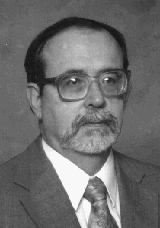
A native of Little Rock, Ark., John S. Morgan retired from DeVry University in Irving, Texas, in 1998 after teaching for 28 years. He earned bachelor’s degrees in biological sciences and electrical engineering from Purdue University and a master’s of liberal arts from Southern Methodist University.