
Matthew Vines’ op-ed in The New York Times (“I’m Gay, Not Queer. It Matters.”), in which he clarifies (?) his identity, presents such a tired, shortsighted argument that at first I couldn’t believe how much of a reaction it provoked in me.
Then John Pavlovitz published something that said the proverbial “quiet part out loud”: That there is a slice of the LGBTQ+ population that tacitly resents the full spectrum of queerness and doesn’t regard us as a community at all.
Here it is:
In the comment section of my friend, Pastor Brandan Robertson, a gay man wrote: “Gay men don’t identify as queer. You need to respect that. We have nothing in common with nonbinary or trans people. It is insulting to have decades of fighting for gay rights coopted by communities that have nothing to do with being gay. Gay rights are not fringe rights.”
This is precisely the worrisome sentiment I find in Vines’ piece: the idea that liberation ever happens in a vacuum.
The truth is, gay men do have something very important in common with nonbinary and trans people and queer people (and every non-conforming human being): The Evangelical Right despises them and wants to take away their fundamental freedoms simply because of their identity and orientation, just as much as it wants to do the same to the queer people these assimilationist gays see as noisier, messier and downright inconvenient.
The violence-prone Christian Nationalist movement in America simply will not stand for any degree of non-cisgender/heterosexual expression, and Vines’ piece seems to me to exist in denial of that. Right now, this Christo-fascist GOP regime is openly targeting transgender people because it’s currently the reddest meat they can toss at their phobic base.
In this environment, it’s hard to to see viewpoints like Vines’ as anything less than conveniently throwing trans and nonbinary people under the bus they’re riding to their own perceived equality in a misguided purification effort aimed at reversing the declining acceptance of gay people in the minds of people whose chief shibboleths appear to be stolen elections and cross-dressing bathroom predators.
Meanwhile, Pavlovitz has diagnosed the open wound at the center of Vines’ essay — and no amount of careful prose, expressed good intentions, or follow-up clarifications are going to close it up.
This is to clarify that I only see Vines as wounded, not hateful. And I say that not to sound dismissive of his hurt, but rather to speak as a fellow traveler, to say that I too know what it’s like to grow up being told your very existence is a theological error — to have learned, early and deeply, that survival sometimes looks like making yourself smaller, quieter, easier.
So many of us internalized the idea of separating ourselves from those who were “too much,” hoping the distance would buy us peace. I understand that instinct in my bones. But understanding what caused a wound doesn’t mean you let it go untreated. It’s quite the opposite: What follows diagnosis is treatment and hopefully, healing.
So, Matthew, let me ask you something directly: Who first taught us to sort ourselves into the acceptable and the expendable? Did that lesson come from within our own community? No. It was handed to us by the very forces that have always wanted us divided, diminished and afraid. When you begin to negotiate on those terms — when you agree that some of us are the dignified kind and others are the embarrassing lot — you have not won a concession.
You have simply asked to be destroyed last.
Pavlovitz, long an outspoken ally and opponent of small-minded Christianity is precisely right when he says: Liberation has never happened in a vacuum. Not once in the history of this movement.
The gay rights victories that Vines rightly cherishes were not handed down from the courteous margins of polite society. They were torn from the grip of an unwilling world by trans women of color, by drag queens, by street youth, by lesbians and gender-nonconforming people who had been pushed so far to the edge that they had nothing left to lose and chose, instead, to fight. The people Vines would now prefer to distance himself from? They built the very road beneath his feet. To walk that road while disavowing the ones who paved it is not honest. It is a betrayal dressed up as self-definition.
I’m sorry Matthew, but you just don’t get a choice about that. Hear the old proverb: If you want to go fast, go alone. If you want to go far, go together.
And we must be clear about what is happening in the world right now, because the stakes are not abstract. The Christian Nationalist movement tearing through our political landscape is not pausing to check whether you use “gay” or “queer.” It is not impressed by your quiet wedding or your mortgage or your Sunday attendance. It does not care. It wants every expression of non-cisgender, non-heterosexual life pushed back behind the wall of shame and silence — every single one.
Today the cruelty is concentrated most visibly on our transgender siblings because for now they seem like the easiest target. Tomorrow the target will move. It always moves. That is what erasure does.
So Matthew, I ask — with genuine care, not cheek — when they come for your trans neighbor, and you have spent years carefully explaining how different you are from her, how your identity is respectable and hers is complicated: Do you honestly believe that distinction will protect you? Do you believe the people who despise her will turn around and open their arms to you?
Spoiler: They will not. The acceptance of those who fundamentally reject our existence is a mirage shimmering at the edge of a desert. We have been chasing it for generations, and it moves farther away with every step we take toward it.
My mind keeps returning to a certain hillside, where I picture the crowd gathered around Jesus — the lepers, the outcasts, the ones polite society had sorted into the “expendable” column. He didn’t stand before them and say, “Some of you I can work with, and some of you make my ministry look bad.”
Jesus didn’t distribute dignity that day based on how easy each person was to explain. The love that drives my faith — the love I believe can transform this world — is a love that refuses to draw the line Matthew Vines asks us to draw. It looks at the whole sprawling, beautiful, complicated, non-conforming family of humanity, and it says: You belong. All of you. Without condition. Without exception. Without revision.
Whosoever. No asterisks.
That is the vision I will not surrender. Not a movement that sands down its edges to fit inside someone else’s comfort zone, but a movement expansive and strong enough to hold everyone the powerful have tried to discard. Our strength has never been our sameness. It has always been our solidarity — fierce, costly, grace-filled solidarity.
Matthew Vines is wrong. Not because he lacks compassion. He doesn’t.
He is wrong because he has placed a desperate bet: That safety lives on the other side of separation. But there is no separate safety for any of us here. History has shown us this, again and again. There is only shared liberation, or there is none.
I will not ration my belonging. I will not trade my nonbinary and transgender siblings for a seat at a table that was never truly being offered to me. The people who built this movement did not survive by leaving each other behind, and neither will I.
We rise together. All of us — the loud ones and the quiet ones, the ones who say “gay” and the ones who say “queer,” the ones who are easy to explain and the ones who are beautifully, defiantly impossible to contain.
We rise together — or not at all.
I choose together. With everything I have, I choose together. Matthew, I fervently pray you will too.
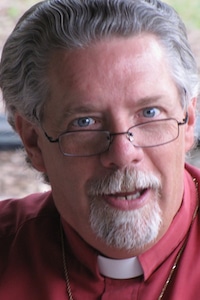
Editor-in-Chief of Whosoever and Founding and Senior Pastor of Gentle Spirit Christian Church of Atlanta, Rev. Paul M. Turner (he/him) grew up in suburban Chicago and was ordained by the Universal Fellowship of Metropolitan Community Churches in 1989. He and his husband Bill have lived in metro Atlanta since 1994, have been in a committed partnership since the early 1980s and have been legally married since 2015.