
Then he said, “Jesus, remember me when you enter your kingdom.” [Jesus] said, “Don’t worry, I will. Today you will join me in paradise.” (Luke 23:42-43)
A few years ago, I was included in a meeting with a group of clergy who had received a large sum of money to be used to feed the hungry.
A good hour into the meeting, the assembled clergy were intently debating the rules for this food distribution. Rules for which people would get the food, rules for how much food they could have, and rules for how many times a month they could have it. Rules for how to complete the necessary paperwork to keep all this on track.
There was even a discussion — no, actually an argument — over how much information could be kept on file without violating people’s privacy.
I found myself getting pretty uncomfortable with the whole discussion, so I stayed silent and was actively devising excuses to slip out of the meeting when one of the pastors called me out. What did I think? He wanted to know. My initial response was that they probably didn’t want to hear what I was thinking. But I was encouraged to share.
So I revealed that the whole time they were debating the rules for how to parcel out this largesse, all I could think of was how Jesus fed 5,000 hungry people. Heads nodded in agreement.
I went on to share that I was stuck on what seemed to me like the stark differences between that story and what was being discussed in our meeting. I could see the nodding slowing down.
Which of the disciples went through the crowd that day and made sure everyone filled out their paperwork? Who helped assess who was really in need? Was there someone who was able to figured out of anyone there was just going from rabbi to rabbi, selfishly hoarding food?
When I finished, I looked around the room and saw frozen faces where moments ago I’d seen grins of acknowledgment at the miracle of the loaves and fishes.
During Holy Week and on days like Good Friday, I find myself reflecting a lot on what Jesus would think of the institutional church of today that operates in his name. I know I’m not the only one who does this — but as a gay pastor leading an LGBTQ+ affirming congregation, I’m also acutely aware of how even the congregations that have done the hard work of having a policy of radical welcome still struggle with the actual practice of it.
I’m acutely aware of it especially on Good Friday because in the story of the Cross, we have a fully formed picture of what can happen when the religious authorities feel their power being threatened by an outsider challenging them to fling wide open the doors of the buildings they’re desperate to exercise dominion within, which contain the people they’ll do almost anything to have hegemony over: They will collude with the government to neutralize that threat.
In the background of that same picture, we also have a fully formed sense of who else gets ground down by the machinery of empire: People who violate the rules because the system isn’t working for them.
We love these stories when they’re just stories. We put on our Sunday best and sing “Hail Thee, Festival Day” and say “Christ is risen,” and we’ve all seen “Les Miserables” in some form in our lifetimes. But let a real Jean Valjean steal a loaf of bread from the local supermarket and watch what happens. Let a real opportunity to practice radical welcome — or even basic charity — come into our midst, and watch what happens.
But the Good News on this Good Friday is that not only does it not have to be this way, but we each have it within our personal spheres of influence to be the change we desperately wish to see in the world, as it were. It starts with a loaf of bread. Or five loaves and two fishes.
It starts with slowing down as you cross through the no-man’s-land between where you live and where you’re going, stopping in a place no one would expect you to stop, and making a difference in the life of someone no one would expect you to be seen with, much less have a conversation with. Where did Jesus announce his ministry? Not in Jerusalem. Not in Judea. Not even in Galilee — but in Samaria, to a non-Jew. To a woman. A multiply-divorced woman drawing water in the middle of the day so as not to provoke her fellow villagers.
That woman is alive today in our midst. She is transgender, and right now our society is so thoroughly provoked by her desire to wear what she wants to wear, to use the bathroom when nature calls, to have her state documents reflect who she really is, and to engage in athletic competition because nothing makes her feel more alive and free than to run as fast as she can.
Our society is so provoked that in the United States alone, no fewer than 740 bills have been introduced in 42 states to restrict transgender people’s free participation in our society. And the church is complicit. In a world where we just can’t seem to fully get rid of old-time anti-gay “conversion therapy,” now there’s “gender exploration therapy” to help trans kids “explore” all the reasons their gender dysphoria isn’t real.
If you don’t think your church has walls, invite a transgender person to sit up front. If you’ve already done that, invite them to participate in liturgy. If you’ve already done that, invite them into leadership. If you’ve already done that, invite them into the pulpit.
Or if any of that makes you uncomfortable, then I think you know where the invisible trip wires are in your own congregation.
It’s funny what can happen when you open the door to let God fully do God’s thing. In 1998 I agreed to lead a small LGBTQ+ affirming church that very quickly came to refer to itself as a “church without walls.” We never got big enough to have our own building, so we met on Sunday evenings in a Methodist church and had office space upstairs. We were cautiously welcomed at first, and within a few years it felt as though we’d always been there.
But I knew that what we really needed was a way to worship in the morning on Sundays, instead of in the evening.
Eight years later there was a change in leadership, and we were told that after much prayerful consideration, they’d decided we needed to be evicted. I was so angry. But one of my parishioners looked out the window at the adjacent park and said, “You know, there’s a mighty fine park right there.”
We’ve now been worshipping there for almost 20 years. More than twice as long as the time we spent indoors. And it’s allowed us to minister to our community in ways I couldn’t have imagined. We’ve served countless potluck meals. We’ve conducted our liturgy as the Lord’s Table, where we have the potluck meal right in the middle of the service. We have homeless congregants who just walk up, often in the middle of the service — and sometimes in the middle of the sermon, and sometimes not quietly — and even though I hate to be interrupted as much as any pastor, I know they’re sent by God on God’s time.
Not to hold my little church up as an example of anything that can be replicated. Our sacristy is a combination of a closet and several plastic bins we call “church in a box.” We don’t have membership, so our voting process for any major change resembles a French parliamentary election. We don’t do stewardship, and we don’t really have a budget.
We do have office space, we do have leadership, we do have an ordination process, and we do pay insurance. We take communion — but we also offer it freely to anyone who is called to the Table, no questions asked.
It works so well for us that we’ve come to think of ourselves as the ecclesiastical version of a feral animal. I don’t think any of us could handle any other kind of church at this point. And I think the fact that we remain as small as we are is an indication of just how much our ferality is truly not for everyone.
But what I fervently wish for all of us in the church universal is that we would genuinely continue to decrease the time we spend on exclusion and the preservation of any “tradition” that ends up being exclusionary, and continue to increase the time we spend progressing toward intentional inclusion of all God’s children. In my deepest heart I believe it’s the only way to progress toward God, and the alternative is — well, the alternative in every sense of that meaning.
Can we truly exchange money and prestige for simple service, exchange moral enforcement and judgment for sharing and proclaiming grace, exchange dogma and creeds for openness and an intentionally inclusive sense of real community?
Because if we don’t, then we’re not a safe space, no longer a locus of peace, no longer a place of refuge from the terrors of the world — and there are so many (to say nothing of the terrors wrought by our own so-called leaders in the faith).
When we crafted the core scriptures of Gentle Spirit Christian Church almost 30 years ago, we challenged ourselves to see and do the following:
- Jesus’ central message is about radical inclusion; thus anyone is welcome to participate in our fellowship without judgment or forcing them to conform to our “likeness” or affirm our creeds in order to be accepted. We invite and offer all a place at the table — no exceptions.
- Faith is not about concrete answers, religious absolutes, creeds, or dogma. Faith is about the search for understanding, the raising of important questions, the open honesty of having doubt, and the realization that no one has it all completely right nor does any human hold all the answers. We seek to follow the advice found in 1 Thessalonians 5:21, which is to “seek truth out in all things and hold firmly onto that which is good.”
- Religious absolutes of dogma, legalism, and strict doctrine become stumbling blocks and “litmus tests” for who is “in” and who is “out” of the circle of God’s grace. These false tests that Jesus never required get in the way of truly following Jesus and his teachings.
- Following Jesus is counter-cultural, radical and disrupts the status quo. The good news of the gospel is intentional in its inclusion of those who are traditionally marginalized and refused by mainline Christianity.
- The words of Jesus found in the gospels are to be the focus for any disciple of him. We submit the rest of Scripture to the position of “sacred commentary.”
- Recognition and affirmation of the differing belief systems of others, whose faiths offer a way into a relationship with God and call upon them to further God’s love and grace on the earth, is crucial. Jesus revealed this path in the acts and works of the Gospel.
In Matthew 5-7 we have examples of Jesus demonstrating this spirit of radical inclusion on multiple occasions — including his announcement of his ministry not in an amphitheater full of faithful Jews, but to a single Samaritan woman scurrying to fetch water from Jacob’s well.
In John 4:1-42, Jesus taught and revealed through example, where any “spiritual” or “non-spiritual” person adhering to this way of life is indeed furthering the reign of God and God’s message of radical love and inclusion here on earth. As Jesus said, “Anyone who is for us cannot be against us.” (Mark 9:39-41)
What does that mean for us?
- It means creating fellowships and communities that are dedicated to lifting up, affirming and equipping one another for the work the Spirit of God has called us to in Micah 6:8 — active peacemaking, striving for justice and equality for all people and nations, loving those who are labeled by our government, society, and — at times — ourselves, as “enemies,” caring for God’s creations, and bringing hope to the poor and poverty-stricken.
- It means God created humans with a brain capable of discovery and reason. God does not require us to “check our brains at the door,” along with our coat and hat to be a part of the faith. Faith and science are not in conflict; they are in harmony. The Bible is not a science textbook and should never be taken as such. We affirm that if God is truth, then any discovery we make about ourselves, our origins, or the way the universe was created has come from God and should not be viewed as heresy.
- It means the church is not simply a four-walled institution, but a ministry without walls that surrounds and encompasses everything and everywhere we go. Our brothers and sisters are not only those who label themselves as “Christian,” they’re everyone we meet.
I don’t believe scripture to be without error, and I also believe that over the years some very important stuff got lost or left out. I also think one must follow the overriding theme of our faith in relation to the “good book,” which is “to do justice, act mercifully and walk humbly with God.” It’s this simple passage in Micah 6:8 that reminds me not to summarily dismiss someone else’s belief system just because they may not subscribe to mine.
On this Good Friday and every day, I fervently pray that if we collectively cannot make today better than yesterday, then may we at least make tomorrow better than today.
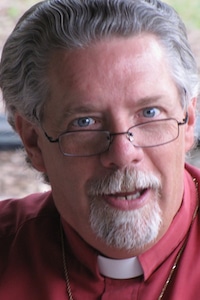
Editor-in-Chief of Whosoever and Founding and Senior Pastor of Gentle Spirit Christian Church of Atlanta, Rev. Paul M. Turner (he/him) grew up in suburban Chicago and was ordained by the Universal Fellowship of Metropolitan Community Churches in 1989. He and his husband Bill have lived in metro Atlanta since 1994, have been in a committed partnership since the early 1980s and have been legally married since 2015.