
Heeding the call for healing
The 2026 observance of Martin Luther King Jr. Day marks the 41st observance of the holiday. Its theme — “Mission Possible 2: Building Community, Uniting a Nation the Nonviolent Way” — already felt challenging in a politically polarized era. With the second Trump presidency, we knew then and know now that we’re called to reaffirm our values and hold them against a hard reality in a way that provides a promise for future generations.
Americans on the margins still have the most to lose in a country eroding, if not outright dismantling, decades-long civil rights gains that were empowering protection and participation in an evolving multicultural democracy.
For Martin Luther King Jr., protecting freedom, justice, and democracy was more than a racial, legal, or moral issue. It was a human issue.
This was evident in King’s passionate concern about a wide range of things: “The revolution for human rights is opening up unhealthy areas in American life and permitting a new and wholesome healing to take place,” King once told a racially mixed audience in 1967 during his “Beyond Vietnam: A Time to Break Silence” speech. “Eventually, the civil rights movement will have contributed infinitely more to the nation than eradicating racial injustice.”
Moral leadership played a profound role in King’s justice work. He argued that authentic moral leadership must involve itself in the situations of all who are damned, disinherited, disrespected and dispossessed, and that moral leadership must be part of a participatory government that is feverishly working to dismantle the existing discriminatory laws that truncate full participation in the fight to advance democracy.
To heal society, we must first heal ourselves
However, if King were among us today, he would say that it is not enough to look outside ourselves to see the places where society is broken. It is not enough to talk, among other things, about institutions and workplaces that fracture and separate people based on race, religion, gender and sexual orientation.
Often, we find that these institutions and workplaces are broken, dysfunctional and wounded in the same ways we are. The structures we have created mirror not who we want to be, but who we are.
King would remind us that we cannot heal the world without healing ourselves.
In the light of King’s teachings, healing ourselves is the greatest task and the most difficult work we must do. This work must be done in relation to our justice work in the world.
In A Farewell to Arms, Ernest Hemingway wrote that the world breaks us all, but some of us grow strong in those broken places. King’s teachings invite us to grow strong in our broken places — to mend not only the unhealthy world we live in, but also the unhealthy world we carry around within us.
If you want to see love, be love. If you want to receive compassion, be compassionate. If you want respect, you must show respect. (Martin Luther King Jr.)
Dr. Bernice A. King is the CEO of The King Center and the youngest surviving daughter of MLK. She said in an interview promoting her 2022 children’s book It Starts With Me: “Stop waiting on the next leader, the next Martin Luther King Jr. It starts with you!”
Bonded in brokenness
I know that the struggle against racism that King talked about is only legitimate if I am also fighting antisemitism, homophobia, sexism and classism — not only out in the world but also in myself. Otherwise, I am creating an ongoing cycle of abuse that goes on unexamined and unaccounted for.
We are foolish if we think we can heal the world and not ourselves. And we delude ourselves if we believe that King was only talking about the woundedness of institutional racism and not also the personal wounds we all carry as human beings.
Ironically, our culture of woundedness and victimization has bonded us together in brokenness. Sharing wounds to depict and honor our pain has created a new language of intimacy, a bonding ritual some feel more able to trust. When we bond in these unhealthy ways, we miss opportunities to work collaboratively with others to effect change in seemingly small ways that eventually lead to significant outcomes.
When we use our gifts to serve others, as King has taught us, we shift the paradigm of personal brokenness to personal healing. We also shift the paradigm of looking for moral leadership from outside of ourselves to within ourselves, thus realizing we are not only the agents of change in society but also the moral leaders we have been looking for.
Therefore, our job keeping King’s dream alive, not just on his birthday but every day, is to remember that our longing for social justice is also inextricably tied to our longing for personal healing. It starts with me. It starts with you.
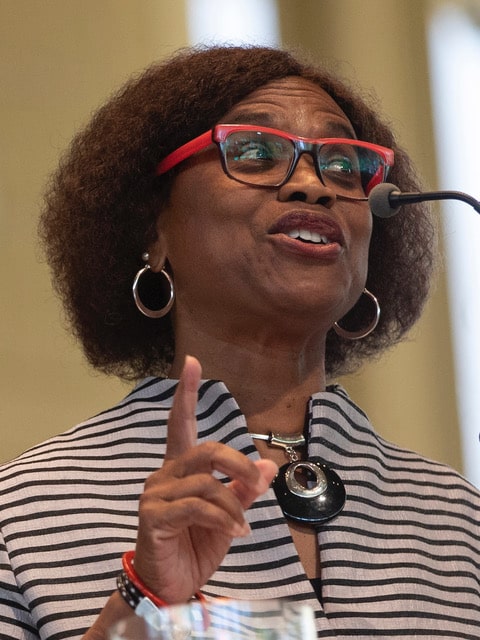
Public theologian, syndicated columnist and radio host Rev. Irene Monroe is a founder and member emeritus of several national LBGTQ+ black and religious organizations and served as the National Religious Coordinator of the African American Roundtable at the Center for LGBTQ and Religion Studies in Religion at Pacific School of Religion. A graduate of Wellesley College and Union Theological Seminary, she served as a pastor in New Jersey before studying for her doctorate as a Ford Fellow at Harvard Divinity School and serving as the head teaching fellow of the Rev. Peter Gomes at Memorial Church. She has taught at Harvard, Andover Newton Theological Seminary, Episcopal Divinity School and the University of New Hampshire. Her papers are at the Schlesinger Library at Radcliffe College’s Research Library on the History of Women in America.