
A confession to the trans woman I failed
She was brave. And I was a jerk. It’s really that simple.
Let me set the stage. Back in the mid-2010s, as a very conservative evangelical straight white man, I was assigned yet another mentee. Nothing surprising — it was one of my three primary job objectives as a senior engineer, and I had mentored dozens of young employees over the years. I consistently got high marks and bonuses based on my mentoring skills and abilities. I knew how to do my job, and I did it well.
And then she showed up at my desk, a new hire I’d never met. And she was trans.
And I utterly failed at my job.
She was the first trans person I ever knew that I’d met. And I’d been carefully trained by my church culture to absolutely fear and loathe trans people, and I am quite certain that, try as I did to be decent and nice, my attitude was was all too evident.
I distinctly remember wondering with amazement how any man could be so twisted as to willingly surrender his masculinity. I’m sure that what I was thinking was obvious in my words, in my tone of voice, and on my face. My gritted teeth were surely visible behind the fake smile.
I failed not only my job of mentoring, but also the test of basic humanity.
I think I met with her maybe four times before she abruptly disappeared — not just from my mentoring meetings, but entirely from our engineering branch. I never saw her again, anywhere in our thousands of employees. And it tells you something about how poorly I regarded her that I don’t even remember her name. I was all too happy to forget all about her for the better part of a decade.
But then in 2022, I became affirming.
Had I helped scare her away?
And now I’m keenly aware that my treatment of her probably was a factor in her departure. If a senior engineer treated her the way I did, what hope could she have in that job?
I desperately wish I could find her today, to offer her a heartfelt apology. I’ve searched my files and my archived emails, and she’s been completely scrubbed from them. She’s lost to me. And I’ll carry my regret at how badly I treated her for the rest of my life.
I’ve spent a lot of time analyzing myself since then, and I have a few observations about what happened.
The main thing that was going off in my soul, as I spent those few hours with her, was fear. No way around it. I was afraid of contamination. I actually distinctly feared that somehow her trans-ness would infect me.
I was also afraid of discovering a real person behind an identity I’d been taught to hate, lest I lose my faith over becoming compassionate to what I’d been taught was sinful. And I was afraid of the blurring of lines between genders, because for much of my life, I’d been taught that the very essence of sin was blurring the line between God’s Truth and anything else — and trans identities were the very definition of that hated and feared blurring.
What produced all this fear? Religion, I’m certain. More specifically, the evangelical world I was raised by.
It didn’t just teach me that some acts of homosexual behavior and gender nonconformity were sinful. It taught me to be deeply afraid of queer people themselves — at a visceral, physical level. That fear was the point. It enforced the boundary more effectively than theology alone ever could.
But one day, I started to change. After some really excellent counseling in 2019, for the first time in my life I learned empathy for people different than me.
‘Don’t call unclean what God has made clean’
And one day, as I was waking from sleep, God gave me a very specific dream: I had a first-hand view of Peter’s dream of the sheet being lowered from heaven, and of Peter being told to rise, kill, and eat things he absolutely knew were unclean (Acts 10:9-16). And in response to Peter’s indignant righteous protest, God told him not to call unclean what God had made clean. Not “what was clean,” but “what was made clean.”
And I suddenly realized, in that moment of sudden wakefulness, that no matter what I had previously believed about LGBTQ+ people, God was telling me that God had made them clean. Since that moment, things have been supernaturally changed for me. Like Peter, I could no longer protest about whatever religious ideas I’d inherited. By divine command, those days were over for me.
Since I “came out” as affirming in 2022, my life has changed, and definitely for the better. I’ve seen queer people through God’s eyes. I’ve discovered how lovely they can be, even when they’re sometimes so different from me. They, like anyone, can have faith that moves mountains, plus a resilience that’s only born from decades of struggle.
I’ve gained numerous queer friends, even discovering after becoming affirming that one of my own family members is nonbinary and in a long-standing queer relationship. And I deeply value each one of my queer friends and family.
But I’ve also found grief, deep grief. Because I suddenly realized what I’d done to that poor woman. And I can never undo it. I can’t even ask forgiveness from her. I just have to sit with that and try to forgive myself. Because I’m sure that Jesus forgave me. But sometimes grieving lasts long beyond the forgiveness.
An ally’s resolve to pay it forward
What I can do, perhaps, is be a better ally. I can’t fix the harm to her, but I can work on behalf of people like her. Stand up for people the world wants to discard. Fight the systems that harm them — especially the religious systems. And be truly, deeply humble, knowing I still have so much to learn. If it’s not my life, I have to listen carefully to those who live it.
And most of all perhaps, even identifying myself as an ally, I have to humbly remember that I’m no savior. Instead, I was one of those bigots holding the hammer, driving home the nails into Jesus’ hands and feet, because Jesus told us in Matthew 25 that whoever does those things to the little ones does them directly to Him.
So to the woman who sat across from me a decade ago and could feel the loathing emanating from me, I say: I don’t know where you are today. I don’t know what you’re doing, or if you’ve found a healthy place without bigots like the former me. I dearly hope so. All I can do, perhaps, is say this: Beautiful one, loved and treasured by God, please know that I owe you a debt that I can’t repay, and I pray that Jesus will repay you 10 times over for what this one of his followers did to you.
I know that Jesus forgave me. But I hope you can too.
Be blessed; I look forward to meeting you again someday in a better world.
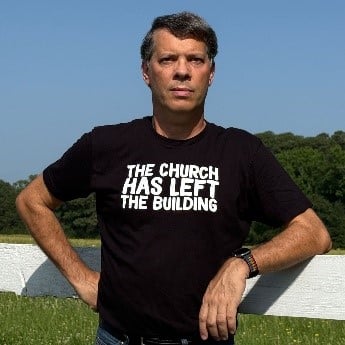
A flight test engineer and former worship leader and lay leader, Brandon Munday is a blogger and podcaster whose writing explores theological deconstruction, the intersections of theology and politics, and what faith looks like outside institutional Christianity. He writes at crucibleofthought.com, where since 2020 he has been documenting his own journey out of more than 40 years of conservative evangelicalism and religious dogma.