
Dear Bro,
I was trying to decide what to wear one day earlier this month, and I realized I had enough rainbow shirts that I could wear a different one each day of October until the 11th, which is National Coming Out Day. Then I thought: Why do I need a special day to prompt me to declare my truth and to live somewhat openly?
I’ve been out a long time, and I still remember that you were the first person I ever came out to. It was when I was back home to attend your wedding to Jan, and you were immediately okay with it, for which I was truly grateful.
Then later that year I came out to Uncle Stanley and Aunt Mary Lou. It just sorta happened. They called, and I wasn’t home, if that tells you how long ago it was. When I called back, they asked where I had been. I said, “On a date.” “So what’s his name?” they asked. I said, “Denise.” And they, like you, were so open and accepting. I still remember that feeling of utter normalcy — to be able to casually let it drop that I was dating a woman who made me happy. I immediately started thinking of who else I could share my good news with.
I didn’t need a National Coming Out Day, because at the time I didn’t even know it existed. I didn’t know about gay pride. I didn’t know anything about the LGBTQ+ fight for equality. I didn’t know there were bars I could go to and meet other people like myself. I didn’t know the lingo or the abbreviations. I didn’t even know what a lesbian was.
Needless to say, I’ve come a long way since then — so far, in fact, that now I think we should expand National Coming Out Day to include other people whose struggles lack visibility. Like the 12-year-old girls in Afghanistan who get told they can’t attend school anymore. Or the folks who don’t conform to society’s rigid norms, particularly around gender; I’m talking about mechanics, doctors, nurses, teachers and blue collar works. Or the folks who still face basic discrimination over race, ethnicity, religion, disability, nationality… If you Google “types of discrimination in society,” set aside some time for the list that comes back — it’s distressingly long.
So how exactly did National Coming Out Day come into being? Here’s what I learned from Wikipedia:
- The Founders: Robert Eichberg was a psychologist and workshop leader from New Mexico, and Jean O’Leary was an openly lesbian activist and head of the National Gay Rights Advocates.
- The Date: October 11 was specifically chosen because it marked the first anniversary of the 1987 Second National March on Washington for Lesbian and Gay Rights, which drew half a million participants.
- The Philosophy: The founders wanted to move away from reacting defensively to anti-LGBTQ+ policies. Instead, they believed that making personal connections — showing that mainstream society already knew, worked with, and loved people who were LGBTQ+ — was the most effective tool to combat fear and prejudice.
Before I read that, I’d had no idea. Also, their instincts were spot-on. Coming out and being out is the single most powerful and courageous thing any of us can do.
My learning journey continued; I wanted to know how Stonewall and Pride fit into the picture.
I turned to Britannica for that and got this: “Stonewall riots, series of violent confrontations that began in the early hours of June 28, 1969, between police and gay rights activists outside the Stonewall Inn, a gay bar in the Greenwich Village section of New York City. As the riots progressed, an international gay rights movement was born.”
Then I learned that the first Pride march in 1970 was to commemorate the Stonewall uprising just a year earlier — establishing the tradition of June being Pride Month.
So much history; so much pride. Knowing all this makes me even more determined to make October 11 a day that I resolve to share with more people the fact that I’m out and proud to be part of the LGBTQIA+ community.
Yes, those letters have grown. We’ve gone from “gay and lesbian” to LGBT, to LGBTQ and to several variations after that — which I take as a strong indication of our commitment to inclusiveness. Our flag has grown as well, from a simple rainbow to a “Progress Pride” version with a lot more colors in it.
So what does LGBTQIA+ stand for?
- Lesbian
- Gay
- Bisexual
- Transgender
- Queer or Questioning
- Intersex
- Asexual/Aromantic
And that plus sign at the end? That’s for the rest of the spectrum of orientation, identity and expression (including pansexuality and nonbinary gender identity), which we’re learning has a fluidity greater than any acronym can contain.
The bottom line? Everyone should be able to be themselves and be accepted just as they are.
Discrimination, sadly, seems hard-wired into the human condition. But that doesn’t mean we have to settle for it or even accept it. Martin Luther King, Jr. fought so hard to make America live up to its own ideals. César Chávez fought on behalf of migrant farm workers. Mahatma Gandhi instigated the fight for India’s independence from the United Kingdom.
Jesus Christ came to share a radically expansive kind of love that showed how all can come to God just as they are. I think that includes gay, black, lesbian, American Indian, bisexual, Hispanic, Transgender, Male, Female, drag queen, queer, intersex, asexual, Jewish, Christian, questioning, atheist, agnostic and any other identity of the human condition. It’s all part of God’s creation.
I may be the only one who feels this way, but I think National Coming Out Day should be for all God’s children. The God I love wants us all to be proud of who we are, and to ignore the inner and outer voices telling us to hide. No one should ever have to live in a closet of theirs or anyone else’s making. In a world where invisibility so often means death, the only life-giving alternative is visibility. There really isn’t any other option. Love you bro.
Love,
Alyce
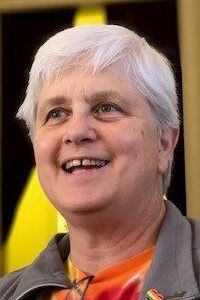
The longtime Vicar of Education for Gentle Spirit Christian Church of Atlanta, Alyce Keener (she/her) has felt a twofold calling from an early age toward teaching and toward God. Her religious education started in earnest at her first vacation Bible school, which spurred the realization at a very young age of how important God and Jesus were in her life. She began to pray daily and later began studying the Bible in earnest in college, where she became involved with the Navigators, later taking classes at Moody Bible Institute. Born in Ohio, she earned bachelor’s and master’s degrees in Illinois, and was active in local churches, serving on a missions committee, helping develop a church library, leading educational programs and directing a young adults program.