
Just over five years ago, an enraged mob desecrated the U.S. Capitol. At present, the interests who manipulated the mob on January 6, 2021 have control over the U.S. federal government. Despite government promises of peace and prosperity, it has brought escalating violence in this new year.
On New Year’s Eve, Kieth Porter Jr, a 43-year-old father of two, was shot by an off-duty U.S. Immigration and Customs Enforcement agent in Los Angeles.
On January 3, the U.S. military invaded Venezuela and kidnapped its president and his wife.
On January 7, an ICE agent in Minneapolis killed a 37-year-old mother of three, Renee Nicole Good. Thankfully, violence by anti-ICE demonstrators on the weekend of January 10 appears to have been limited to one rock-throwing incident.
In these situations, federal authorities are the overwhelming perpetrators of senseless violence. Regardless, social and traditional media for very different reasons seem destined to portray the escalating tensions on both sides of the struggle as though they are equal. In this context, any effort an individual might make to promote peace is doomed to be unheard, unseen, unread.
Twenty-two years ago, I organized against President George W. Bush’s invasion of Iraq. At the time, I felt my efforts were wasted. I realized that peace and goodwill cannot thrive in a world-system dominated by anger, intolerance, and greed. On a positive note, I felt a kinship with the Psalmist who lamented:
Woe to me that I dwell in Meshech, that I live among the tents of Kedar!
Too long have I lived among those who hate peace.
I am a man of peace, but when I speak, they are for war. (Psalm 120:5-7)
In hindsight, I realize that I was not alone in my protests against the Iraq War. I was actively building community with the Quaker Society of Friends and the United Methodist Church.
Through the living legacy of scriptures and the testimony of spiritual communities, I have discovered strength beyond my own individual voice.
Today, I lack such a peace-promoting religious community with whom I can meet in person.
Rather, my wife and I have made the difficult decision to wash our hands of the militaristic violence of the U.S. system. We emigrated away from Meshech and away from the tents of Kedar.
We ultimately found residency in Costa Rica, a nation devoted to pacifism. Unfortunately, pacifism is not a shield against aggression. All nations in the Western Hemisphere will be vulnerable to U.S. aggression up until the day the U.S. government ends its predatory policies.
Again, I need a community of active peace advocates.
In the causes of peace and nonviolent conflict resolution, the individual is weak. It takes a community to make a difference. Historically, churches have served as communities that promoted nonviolence. “Peace Churches” such as the Quaker, Mennonite, African Methodist Episcopal, and Roman Catholic, to name a few, have strong traditions of promoting nonviolence.
Unfortunately, the U.S. is in the midst of a “great unchurching” where an unprecedented 15,000 churches shut their doors in 2025.
Before the 2020 pandemic, up to 1.2 million Americans stopped attending church each year; after 2020, it is believed that this annual number increased. In addition to providing community services such as homeless ministry and civic group meeting places, churches have served as institutions promoting nonviolent conflict resolution.
It is frightening that as state-sanctioned violence and street-violence increase in the U.S., the moderating influence of these church institutions is in decline. Alternative forms of in-person communities are urgently needed for the cause of peace.
In urban and suburban areas of the U.S., LGBTQ+ communities are well-positioned to take the lead in promoting nonviolence. The LGBTQ+ community (and especially trans people) are currently targeted for persecution by all levels of government.
LGBTQ+ groups have the experience and tirelessness to be a powerful presence for goodwill. Gay bars have traditionally been the LGBTQ+ community gathering place and those that remain should continue as such.
Yet new LGBTQ spaces need to be created that are sober-friendly. There need to be community drop-in centers, 12-step programs, meditation/yoga classes, folk music jam groups and much more. LGBTQ+ people are never short on creativity and resourcefulness.
When we speak as a community, the warmongers are less able to shout us down. LGBTQ+ communities can build our own churches or alternative sacred spaces. LGBTQ+ people are uniquely qualified to build spiritual community, because we typically live lives of radical honesty and detest all forms of violence.
Whether Christian, Jewish or Neo-pagan, LGBTQ+ spiritual groups value nonviolent resolution of conflicts. By contrast, some secular militant LGBTQ+ groups may succumb to the temptation to employ violent tactics for resistance.
Thus, traditional and non-traditional spiritual practice offers paths toward peace and liberation. As young LGBTQ+ people often feel triggered by church, the onus is on Christian, Jewish and Neo-pagan leaders to create safe spaces (non-church buildings) for our young people. Coming together in-person is imperative today. When we commit to nonviolence together and when we speak as a community, the warmongers are less able to shout us down.
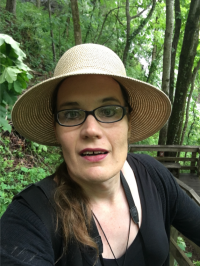
When she is not analyzing viral DNA at the Centers for Disease Control, Dr. Darlene Wagner is traveling with her wife, Monica Helms, helping with home improvement projects, or supporting the Atlanta trans community through advocacy. Raised Evangelical Christian and currently identifying as Universalist Christian, she is a member of Pilgrimage United Church of Christ in Marietta, Ga., and enjoys hiking, photography, blogging, woodworking and gardening.