
Across the United States, a wave of anti-transgender legislation is reshaping access to public space. As of last moth, 44 bathroom-related bills were under consideration, with six already enacted in states including Florida, Idaho, Missouri, Oklahoma, South Carolina and Texas. Several of these laws impose steep fines and serious legal consequences.
In Idaho, for instance, a violation could result in a felony conviction and up to five years in prison. Even the Idaho Fraternal Order of Police raised concerns on who was going to implement the restrictions, noting in comments to the Idaho Capital Sun:
In many circumstances, there is no clear or reasonable way for officers to make that determination without engaging in questioning or investigative actions that could be viewed as invasive and inappropriate.
As an African American, I see unmistakable parallels between the denial of restroom access to transgender people today and the segregation of the Jim Crow era, when Black Americans were barred from lunch counters, water fountains and restrooms in public spaces. As a lesbian, I also recognize how policing who belongs in which bathroom harms not only transgender people, but also nonbinary and gender-nonconforming individuals — especially when judgments are made based on appearance, such as labeling a woman “too butch” or a man “too effeminate.”
Public restrooms were a flashpoint during the Jim Crow era, much as they are now. The Civil Rights Act of 1964 outlawed discrimination based on race, color, national origin, sex and religion, mandating the desegregation of public accommodations, including restrooms.
Decades later, the Obama Administration expanded federal protections to include LGBTQ+ Americans. However, in 2017 the Trump Administration rescinded guidance that had allowed transgender students to use facilities aligned with their gender identity, arguing that existing civil rights law did not explicitly cover gender identity.
Support for these restrictive laws is often rooted in a fundamentalist interpretation of religious doctrine that frames biological sex as fixed and binary akin to skin color. This perspective continues to influence public policy debates, even as it collides with the lived realities of transgender people.
Meanwhile, many of these bills are justified through claims about safety — invoking fears of predators, voyeurs, rapists and assaults in public restrooms.
Yet there is no credible evidence to date that trans-inclusive policies increase such risks. In fact, research consistently shows the opposite: Transgender individuals are far more likely to face harassment or violence when denied access to appropriate facilities.
The simple statement “A trans person peed here, and no one was harmed” cuts through the transphobic and fear-mongering rhetoric. It highlights a simple truth: Inclusion does not create danger — exclusion does. Denying access to safe restrooms places transgender people at real risk, reinforcing the urgent need for inclusive, all-gender or gender-neutral restrooms.
This struggle is not new for transgender Americans accessing public bathrooms. Anti-trans “bathroom bills” gained national attention in 2016, when North Carolina passed HB2, the first state law restricting transgender restroom access. Since then, the fight has continued to center on a fundamental question: Who has the right to exist freely in public space?
As Laverne Cox explained in a 2017 interview underscoring how these policies reach far beyond bathrooms, they shape whether transgender people can safely participate in everyday life.
“When trans people can’t access public bathrooms we can’t go to school effectively, go to work effectively, access health-care facilities — it’s about us existing in public space,” Cox stated on the MSNBC show “Hardball with Chris Matthews” in 2017. “And those who oppose trans people having access to the facilities consistent with how we identify know that all the things they claim don’t happen. It’s about us not existing — about erasing trans people.”
Cox is a black trans actress and activist. She is widely known for her breakout role as Sophia Burset, a transgender woman incarcerated for credit-card fraud, in the Netflix series “Orange is the New Black” that debuted in 2013.
What emerges from this debate is a troubling pattern.
Conservative political and religious movements have always been a demographic group obsessed in regulating bodies, particularly policing this nation’s genitals — what they do, how they use them, what bodily orifices they enter. Now with transgender bathroom bills across the country, it includes where they take theirs to go relieve themselves.
These bathroom bills effectively criminalize a routine human need, turning it into what amounts to a “toilet crime.”
But the real crime lies elsewhere: In the failure of lawmakers to protect the dignity and safety of transgender people. Access to a restroom is not a privilege, it is a basic human necessity. And when that access is denied, it becomes a question not just of policy, but of fundamental equality. This is the type of injustice African Americans faced during the Jim Crow era. Some things just never change.
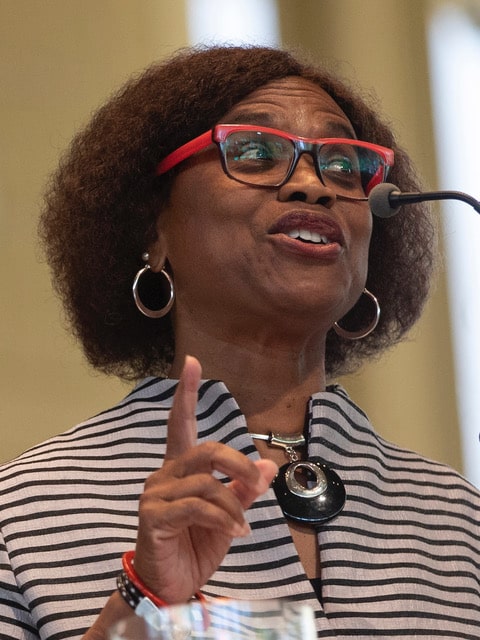
Public theologian, syndicated columnist and radio host Rev. Irene Monroe is a founder and member emeritus of several national LBGTQ+ black and religious organizations and served as the National Religious Coordinator of the African American Roundtable at the Center for LGBTQ and Religion Studies in Religion at Pacific School of Religion. A graduate of Wellesley College and Union Theological Seminary, she served as a pastor in New Jersey before studying for her doctorate as a Ford Fellow at Harvard Divinity School and serving as the head teaching fellow of the Rev. Peter Gomes at Memorial Church. She has taught at Harvard, Andover Newton Theological Seminary, Episcopal Divinity School and the University of New Hampshire. Her papers are at the Schlesinger Library at Radcliffe College’s Research Library on the History of Women in America.