
Transgender Day of Visibility is a necessary reminder to honor and uplift transgender and nonbinary people. It is also a day to celebrate the lives and contributions of trans and nonbinary people, while acknowledging the harsh reality of the continued assaults on the community.
In commemoration of TDOV in Boston, The Theater Offensive, in partnership with LGBTQ+ Elders of Color, hosted a mutual aid market alongside a conversation series titled “Stories of Becoming” with local Black trans community leaders about their journeys, which too often are not heard in either straight or queer media or communities.
As the event’s promotion beautifully affirmed: This was a space to witness and celebrate “How one still stands in their power at a time when the world wants them to fall down.” And Black trans joy was on display at the Boston Center for the Arts.
Flipping the script
“Being trans is more than a tragedy story — especially being Black and trans,” said the theater’s executive and artistic director, Giselle Byrd, the first Black trans woman in the country to head a regional theater. “We create beauty in the face of erasure.”
The dominant “Black trans tragedy” narrative in the media obfuscates the full humanity and achievements of Black trans people. This is despite the fact that Black trans individuals were foundational leaders in the modern LGBTQ+ civil rights movement, beginning with the Stonewall Rebellion in 1969. Their contributions have been whitewashed — rendered invisible, if not erased — due to the intersecting oppressions of racism, transphobia, and misogynoir, within both white, straight society and in queer communities themselves.
However, Byrd’s vision of acknowledging the full humanity of Black trans people is transformative. Since taking the helm of TTO, she has intentionally centered Black trans lives.
In an Oprah-style “Super Soul Sunday” format, Byrd facilitated two moderated conversations, posing questions not often asked of Black trans people:
- How are you claiming joy?
- What sacred aspects of your childhood shape who you are today?
- Who were your role models?
- How do you care for yourself?
- What legacy do you hope to leave through your work?
A man about justice
One of the stories we rarely hear within trans and nonbinary communities is that of Black trans men and Black transmasculinity.
As they navigate the world, Black trans men confront both anti-Black racism as men and also transphobia. These forces intersect in ways that further marginalize their visibility, limit their protection, and restrict access to resources and opportunities.
Justice Williams understands the challenge. He works in the Boston Mayor’s Office of LGBTQIA2S+ Advancement as a Community Relations Specialist, a role that reflects a lifelong calling to community activism — one he genuinely enjoys.
His commitment to advocacy began well before relocating to Boston from New Jersey. “My first act of activism,” Williams recalls, “was fighting for African American history classes in my high school — and winning.”
That same passion and determination now fuels his work across Boston’s diverse neighborhoods. As a community relations specialist, Williams leads initiatives focused on education, engagement, and empowering communities.
Justice shared with the “Stories of Becoming” audience that he came out as trans later in life. He spoke about how society places people into boxes that fail to capture the fullness of one’s identity and humanity.
“I was Black before I was anything else,” Williams said. “My Blackness holds an expansiveness that no box can contain.”
Williams also emphasized that he uses the spaces he occupies to raise awareness about the violence facing Black trans women: “I talk about Rita Hester. I’ve brought people together in her name.”
Rita Hester, a Black trans woman, was murdered in November 1998 in the Allston section of Boston. Her killing sparked the “Remembering Our Dead” web project, which became the catalyst for the International Transgender Day of Remembrance, observed annually on November 20.
Teasha Purdy: Queen Mother
Teasha Purdy is a beloved and revered Black trans woman in her community. A renowned performer, Purdy has also been a tireless activist, working in the political sector for more than two decades on behalf of trans and nonbinary equality.
Despite the many accolades and awards she has received, Purdy takes the greatest pride in her role as a chosen mother, having mentored and supported numerous young people who have gone on to thrive in their own lives. One of her children is Candace Persuasion of the Boston Dolls — a trans Asian performer.
Byrd asked Purdy if she could recall her first experience of motherhood. Purdy shared that she began her journey with three children.
“They just showed up. I didn’t know what I was doing. I just jumped in,” she said with a laugh. “I knew these kids were having problems at home and were unhoused.”
Black transgender and nonbinary youth face an elevated risk of homelessness due to overlapping factors, including family rejection, systemic transphobia and racism, and discrimination within the foster care and justice systems.
This crisis is further exacerbated by current political climates, cultural tensions, and the influence of the traditional Black church. Across the African diaspora, the intersection of race, gender identity and sexuality is often shaped by conservative religious beliefs. According to a 2022 Pew Research Center report, approximately 70% of Black Protestants believe that gender is immutable — fixed at birth, much like skin color.
The traditional Black church has often, and at times unapologetically, closed its doors to LGBTQ+ people. Even as many of these youth turn to the church for refuge, they frequently find neither support nor sanctuary.
Purdy, a “PK” (pastor’s kid), grew up within the Black church but was raised in a loving and affirming religious family. “My mother took a moment,” she recalled, “but my grandfather simply asked, ‘So what’s your name?’ ”
Living beyond the day
Anti-trans bills have surged in 2026 in just the first three months of the year. As of late March, according to the Trans Legislation Tracker, more than 680 anti-transgender bills have been introduced or are currently active. Of these, 22 have already passed and 31 have failed. Even in my progressive home state of Massachusetts, six bills are being tracked.
TDOV brings the community joy. Joy, however, is not reserved only for non-trans people.
Joy is expansive, because it deepens our capacity to love, accept ourselves and others. It transforms existence from simply survival to truly living one’s authentic selves.
The transgender community deserves more than just a single visible day to experience what others can take for granted every day.
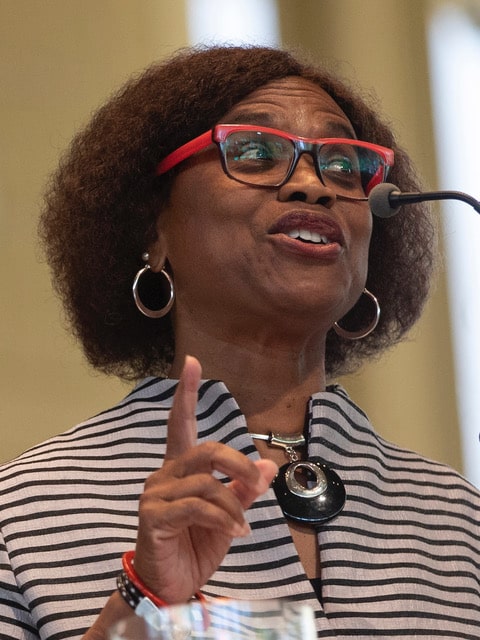
Public theologian, syndicated columnist and radio host Rev. Irene Monroe is a founder and member emeritus of several national LBGTQ+ black and religious organizations and served as the National Religious Coordinator of the African American Roundtable at the Center for LGBTQ and Religion Studies in Religion at Pacific School of Religion. A graduate of Wellesley College and Union Theological Seminary, she served as a pastor in New Jersey before studying for her doctorate as a Ford Fellow at Harvard Divinity School and serving as the head teaching fellow of the Rev. Peter Gomes at Memorial Church. She has taught at Harvard, Andover Newton Theological Seminary, Episcopal Divinity School and the University of New Hampshire. Her papers are at the Schlesinger Library at Radcliffe College’s Research Library on the History of Women in America.