
St. Paul-Reformation Lutheran Church, St. Paul, Minn.
Reading for the Fifth Sunday after Pentecost: Matthew 10:40-42
Holy God, holy and mighty, holy and immortal, have mercy on us. Dear brothers and sisters in Christ. It is oftentimes the task of a pastor to spend a good deal of time during the week teaching various classes: catechetical school classes, Bible study classes, new member classes ~ you can come up with any number of them. I know that there is some chance that some of you are engaged in the profession of teaching in one way or another. If you are at all like me, you find yourself frequently standing up at the beginning of a class and saying, “Let’s review.” So, I would like to begin today’s sermon by saying, “Let’s review.”
Since the Feast of the Holy Trinity we have been in the 10th chapter of Matthew and today we read the end of that chapter. It has been difficult reading, but important reading, because in it Jesus sets the stage for all that we are to do as his disciples during the great “green season” [Pentecost season] when we move on from the business of renewing in our heads and in our hearts the story of our Lord’s work among us and take up, instead, the apostleship and go out the door and start doing the work of a disciple sharing all that we have experienced in the first half of the church year – the Semester of the Lord – by doing the work of discipleship in the Semester of the Church.
Now, I have to go on faith that you have all faithfully been here or other places for the past five weeks so that you have read the rest of the 10th chapter of Matthew. So, let me review just a little bit. Jesus says to his disciples, I want you to go out, and when you go out, I want you to proclaim the good news that the kingdom of God has come near. I want you to put that into effect by healing the sick, by casting out demons, by raising the dead. And on that first Sunday everybody, I think everybody, nods their heads and says, “That’s sounds cool!” “Good news! I like that!”
Then immediately thereafter, the next week, actually, (it’s sometimes too bad that we cut the stories up; we sort of need to hear them all together), Jesus says, Oh, and by the way, while you are doing this people are going to get mad at you.
Now, I’ve always thought that that was very important right there, because as we deal with the human condition, as we talk about the world in which we live, as we deal with society and culture, one has to ask the question: “why in the world would telling good news, raising the dead, healing the sick, casting out demons, doing nice things for people, why would that get you into trouble? But if we are at all honest, we know that’s precisely what happens. Because in giving effect to the kingdom, the kingdom “whatever you want to call it” in giving effect to God’s loving address to us, we undermine the way in which this world works. For most of us, we’d much rather take a familiar hell than an unfamiliar heaven.
The Word of God turns what we are accustomed to on its ear, sets it upside down, saying, we’re not going to do it that way anymore. If any of you have ever been to Synod assemblies, or, worse yet, national assemblies, you know that the sovereign argument that is used in contradiction to any proposal is, “we’ve never done it that way before.”
So, right from the start we recognize that being a person who follows the Gospel doesn’t make you a particularly good Lutheran. I’m sorry to say that, but it’s true, because it says that you have to do things in ways that you have never done them before. We’re not accustomed to that. It gets worse, by the way. Because not only does it say that you’re going to get into trouble with strangers. Of course, Lutherans have trouble with strangers to begin with. You all know that the Vikings had a great reputation for being raiders, but they didn’t raid very often, because they spent most of their time in their longship off the coast talking about whether the villagers were going to laugh at them and saying, “but we don’t know anybody there.” Then as Ragnar the Terrible said, “if you’re going to argue like that I’m going to turn this ship around.” And they’d go back to Norway.
Not only will you have trouble with strangers, but then the next week it says we’re going have trouble with family. It’s not going to make family life easier. We are going to be at odds with each other over the Gospel, because once again it is going to call us to do things in ways that we have never done them before.
Now let us jump to today’s Gospel. We are at the end. It seems pretty simple, and now it even turns nice again. You don’t happen to have the bulletin service from the ELCA, but I do in my congregation and there is this nice essay on the back of it about hospitality. I love that. Gay, lesbian, bisexual and transgender people, we have a special place in our hearts for hospitality. You see, for three or four thousand years we have been given the short end of the stick because of the inhospitality of Sodom and Gomorrah.
Everybody says, “ooh, that’s your fault.” Of course, they tend not to think of it in terms of hospitality or inhospitality. In fact, I find it interesting these days that if you are called into a debate about those particular passages, if you say, “well, this is a passage about inhospitality,” people sort of scratch their heads and look at you rather angrily and say, “Oh, it has to be much more serious than that!”
Well, again, my brothers and sisters, here is a way in which we have to do things in ways that are different from any way we have done them before. We need to learn a new lesson. We need to recognize that as we see with God’s eyes we are going to see things differently. In Scripture, inhospitality is not a little thing! It’s not a failure to answer the door when someone rings the doorbell. It’s not forgetting to bring a hotdish to the potluck supper.
Hospitality in Scripture, you have to remember, arises out of a Bedouin culture where they are living on the edge of the desert. When people stumble into your tent, if you don’t give them food and a drink of water, they die. The reason that everybody hated Sodom and Gomorrah was because the people [portrayed in the Genesis 19 story] were mean, vicious people. They took advantage of people who wandered out of the desert. They robbed them. Throughout the history of the people around the Mediterranean that was about the worst thing you could do.
Now hospitality comes up again. We are told that we are to receive the disciple, we are to receive the prophets, we are to look after the needs of the little ones, even to giving them a cup of cool water. That’s not phrased as the nth degree of hospitality, that’s the first degree of hospitality — giving them something to drink.
Now in typically Gospel fashion, I would like to say that as heinous as inhospitality was in the Old Testament, Jesus ups the ante. He did this also, by the way, in this passage from Matthew two weeks ago when he said that if you don’t listen up it will be worse for you on the day of judgment than it was for Sodom and Gomorrah. What’s all that about?
Well, in general, when you are not hospitable to people who wander out of the desert, they die. But Jesus is reminding us that if we are not hospitable to the disciples and the prophets when they come bringing the Word of life to us, then we die — and not just of hunger. We die eternally. We are then without life. We are without hope.
So, all of a sudden, this business about welcoming — this interaction between those who bear the Word and those who receive the Word — is not only a matter of life and death, it is a matter of eternal life and eternal death.
Now, let’s review. We’d better listen up. Short and sweet. My brothers and sisters, it is up to us not only to hear the call which the Holy Spirit brings to some of us, all of us in some way, but some in more measure than others, to bear public witness to God’s redeeming, liberating, transformative word of life and hope. Don’t think somebody else will do it. There are too few of us. We need more people who do the work of the disciple, who do the work of the prophet. I don’t think it’s easy or inconsequential. I think it’s important. Please, oh, please, my brothers and sisters set about that task.
But also, do it with at least one ear open all the time, because at the same time that you may be bringing the word, somebody else, you can be assured will have a mission from God to bring the word to you. For we are in partnership, in community, and we need the diversity of experiences and the diversity of the hearing that God brings to each and every one of us. And this is where it gets really painful.
Personally, as you know, I am caught up in a particular struggle right now. It has been going on in the life of the church for years. We have been trying to decide and determine and discern what is God’s will for us in terms of the participation and inclusion of sexual minority people. It’s not a new question. We spent a lot of time wrestling with what’s the place of women in the church. We spent a lot time dealing with the question of what’s the place of people of color in the church. We still wrestle with what is the place of those people who are poor, or those people who are handicapped, or come up with almost any kind of category. We excel at categorization. We come up with all kinds of labels and we always ask ourselves afresh for some reason, we never learn ~ we never get any carry over, we always ask, “and what is your place in the church?” And we struggle with it.
And right now, on this day, we’re talking about the struggle for gay, lesbian, bisexual and transgender people to feel at home and welcome in the church. Actually, we have been making faster progress than a lot of people ~ I mean, women took 2,000 years. And at most, we’ve only been at it for about 100. Maybe even really only 30, hard core.
But, what’s the response?
We’ve never done it that way before! Surprise!
Let’s study it! Thank you for the results of that study. What shall we do with them? Let’s study them! And then what will we do? We’ll study them again. Perhaps always in the hope that somehow or the other it will come out different in the end.
My brothers and sisters, I would like to posit that a small girl comes to the door and asks for a cup of water. And if you respond, “let me study that,” you’re a nasty person. You are flying in the face of the Gospel. The way the church deals with trauma now, and controversy now lots of people would have died of thirst in the desert, all piled up outside the Bedouin camp while there was a study going on of why these people were thirsty; are they to blame for their thirst? was it poor planning on their part? did God really intend for them to drink that much? will there be enough to go around? does their thirst somehow demean my thirst? It gets scary.
So, what do we do? I understand there’s an article in the paper yesterday or today where someone talks about seventeen passages of Scripture that tell us about how God has already solved the problem. I think I could come up with a lot of people with lots of degrees who would say that these same seventeen passages solve nothing.
Well, maybe we should have started reading Matthew in the chapter before where Matthew started talking about how you decide whether or not you find good fruit by looking at what’s on the tree. You know, you don’t go to the thorn tree looking for olives. Well, I look around me and at my gay, lesbian, bisexual and transgender brothers and sisters who are faithful Christians, and I notice that they happen to be bearing the fruits of the Gospel. They happen to do the work of discipleship. They happen to do the work of the prophet.
Now, I have a great deal of honor for the ancient office of deacon, but I don’t think that Anita is called to wear her stole catywampus forever! [Anita Hill is Pastoral Minister at St. Paul-Reformation, who is excluded from being ordained because she is lesbian in a committed relationship.]
We have a tendency to think that we pass out titles in the church like we give out pats on the back. It’s not about honor, it’s not about sitting on your laurels and saying, “ah, a good job!” We pass out titles because we also hand out responsibility. Anita has the one without the other. It’s about time that we got a little congruency in our thinking for a lot of people.
My brothers and sisters, we are called at this point to do the work of prophets. I would like to suggest that although our Lord tells us it will be tough going, that there will be controversy, and we will do things in ways that we have never done before, he does not say anything about patience, or waiting, or starting new studies, or waiting until the time is better or until the people to whom we are bringing the Gospel are a little more comfortable. I’m sorry. The time for that is past.
Instead, we are given the simple command to do the work, be prophets, do the work of love and healing and at the same time receive them [the gifts of love and healing] from our sisters and brothers around us. The church may think that the Gospel doesn’t matter to all of us, that we are infinitely patient in waiting for someone to deign to offer the cup of cool water which is the Word of life and to say welcome into God’s family. But as it is in the desert, so it is in the church today. Such welcome is a matter of life and death. And I, for one, wish no one else to die either in body or in spirit. I’m not talking just about the pain of gay, lesbian, bisexual and transgender people.
I’m talking about the harm that is done to the soul of each and every one of the faithful when God’s gift of love is cheapened and made conditional and tentative and timid in a world that is rampantly evil and death-mongering. The Word of life needs to be put forward as powerfully.
I used to be a nice Lutheran kid. That didn’t stop when I discovered I was gay. I was still a nice, Lutheran gay kid. When it did stop was when my church family with whom I had grown up decided that it didn’t like me anymore. I don’t do that to my daughters. I’m not going to let the church do it to me. There are no asterisks in the baptismal liturgy. It does not say, “I baptize you in the name of the Father the Son and the Holy Spirit * asterisk: see below; unless, of course, you are gay, lesbian, bisexual or transgender, divorced, a person of color, a radical — any number of other things.” There are none of those conditions. We will tolerate none of those conditions.
I haven’t said the word “pride” at all, because I’m not particularly proud today. I’m actually angry, sometimes, even in my own community, because I think we have been timid. We have also not been honest with each other about the brokenness in our own lives and the pain and how hard it is to feel that. We have perpetuated some of the evils on our sisters, on persons of color “we certainly are materialistic” all kinds of things. Let’s not let that go on either.
My brothers and sisters, as we gather today only one benefit matters. It is God’s loving proclamation that whoever you are, whatever you are “YOU ARE LOVED! You are acceptable! You are the icon of the Christ. You are made in the image and the likeness of God and no greater dignity is possible, desirable or worthwhile.”
The Gospel lesson for today says that each and every one of us, as we are joined to the Word of life, as we do the work of the apostle, as we do the work of the prophet, as we serve each other’s basic, intrinsic needs, so beautifully represented in that cup of cool water, we will not lose our reward. We will not lose life. We will not lose dignity. No one loses their life, no one loses their dignity, no one loses their reward just because someone else has all of that, too.
But, Pastor, we’ve never done it that way before! Then it’s high time we did. AMEN!
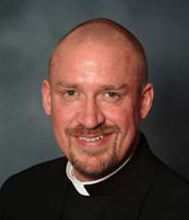
Rev. Steve Sabin gained national attention in 1998 when his bishop, Philip L. Haugen of the Southeast Iowa Synod of the Evangelical Lutheran Church in America, removed him from the ELCA roster of ordained ministers after a church trial during which he was found guilty of violating an ELCA statement that “ordained ministers who are homosexual in their self-understanding are expected to abstain from homosexual sexual relationships.” He was formally received into the ELCA again in 2010 after the denomination changed its rules to allow gay clergy in committed relationships to serve. He earned a bachelor of science from the University of Iowa and a master of divinity from the Lutheran School of Theology in Chicago.