
Seemingly in spite of all the advances LGBTQ+ people have made in the United States, the society we live in can still seem very dangerous and scary for us. After all, we’ve made so much progress since that night at the Stonewall Inn.
In the U.S. at least, it’s against the law to kill us out of hate and fear. Our desire to love who we love is no longer classified as a psychological disorder, our gathering places aren’t being raided, living with HIV has become manageable, and our relationships are legally recognized.
And yet, with a single election and the return of a president whose only consistent trait seems to be chaos, all that security feels as though it’s truly in jeopardy, and many of us have returned to a state of terror, or at least heightened vigilance.
Where can we turn for solace?
For starters, I’d like to recommend the best-known Psalm, the 23rd one — as an assurance and an an affirmation that we have every reason to live as joyously as ever rather than losing hope.
Psalm 23 is one of the most profound pieces of scripture; it’s a timeless melody heard in hospital rooms, whispered in moments of grief, and recited during trials and triumphs alike. For many it feels like a benediction, a parting word of comfort and reassurance — but I want to challenge us to see it differently today.
I want to ask you to hear it, not as a closing blessing, but as an invitation to live boldly and faithfully. Psalm 23 is less a benediction and more a license to live.
It begins with one of the most defining statements of faith and trust in all of scripture:
The Lord is my shepherd, I shall not want.
What does this mean to an inclusive, progressive community today? What does it mean to people living in a world full of scarcity, inequity, fear, and anxiety?
Translated for our understanding, it might sound like this: “I already have everything I need. Everything I am is enough. I am situated within the abundance of God’s care.” And when you’re nestled in lush meadows of God’s provision, when you breathe in deeply by the quiet waters, God gives you permission to exhale — to rest, recharge, and simply be.
Rev. Troy Perry, founder of the Metropolitan Community Church, understood this when he titled his book: The Lord Is My Shepherd and He Knows I’m Gay.
So many of us can make the same claim (adapted for a more modern sensibility about gender):
The Lord is my shepherd, who knows I’m trans.
The Lord is my shepherd, who knows I’m nonbinary.
The Lord is my shepherd, who knows I’m divorced.
The Lord is my shepherd, who knows I’m sick.
The Lord is my shepherd, who knows I’m overweight.
And because the Lord, your shepherd, “sends you in the right direction,” you’re reminded that you’re not wandering aimlessly. There is a purpose for your living, and there’s caring guidance in every step you take.
Psalm 23 is, above all else, a song of reassurance that God is perpetually ushering us toward fullness of life. It invites us into the spiritual act of knowing that you don’t have to do it all on your own.
From the meadows to the valley
But then the psalm shifts. It moves from the comfort of meadows and still waters into something much darker.
It’s the part so many of us know painfully well. Life doesn’t linger in lush meadows forever. Sometimes we find ourselves walking through valleys drenched with shadows, or as the psalmist writes, “The valley of the shadow of death.”
The beauty here is not the absence of fear or hardship — it’s the presence of God alongside us. “I fear no evil,” the psalm says, “for you are with me.”
Whatever the darkness looks like in your life today — that diagnosis, the crushing grief, the uncertainty of tomorrow, or starting again after failure — this is where faith takes on muscle. God doesn’t promise to remove the valley; God promises to walk with you through it. The rod and the staff aren’t just tools of comfort; they’re reminders that we’re never abandoned, even in our most vulnerable seasons.
I think of the famed Brooklyn Dodger, Roy Campanella, who when paralyzed in an accident that could have easily stripped him of joy and hope, faced his own shadows of despair by turning to Psalm 23 and finding it to be not an invitation to surrender, but a declaration of resilience. He said, “From that moment on, I was on my way back. I knew I was going to make it.”
What valleys are you walking through today? And can you, like Campanella, lean into the psalm’s promise of companionship and endurance?
The banquet table
Next we arrive at the banquet table. “You prepare a table before me in the presence of my enemies. You anoint my head with oil; my cup overflows.”
Here, God does not eliminate enemies; God doesn’t “fix” everything or remove the challenges. Instead, God provides abundance and honor — in the midst of adversity. A feast is laid, not when the battle is over, but even while the struggles rage.
Think about that.
The homophobes aren’t going away, the trans-haters aren’t going to stop, the “Proud Boys” and the Ku Klux Klan aren’t going to be converted to a community of do-gooders and justice seekers — at least not overnight, or even all at once.
The banquet imagery is no small metaphor. God’s table is an audacious declaration that life is still worth celebrating amidst chaos.
And more importantly, God’s table is radically inclusive. There’s a spaciousness here, a place for every person, every background, every struggle, and every gift. God does not host this table in some distant heaven; God hosts it in your life, today.
Your cup is not merely full. It “overflows.” That’s an abundance. That’s the affirmation that whatever gifts you’ve been entrusted with, whatever love, talents, and blessings you hold, they are more than enough, poured out for the good of others.
Why sheep?
Now, it’s worth asking why the psalm begins with a surprising metaphor — that of God as a shepherd and of us as sheep. After all, sheep aren’t the most majestic animals. They lack independence. They’re not brave. They can’t stampede or fight. At first glance, sheep seem like an odd choice to represent discipleship.
Yet, sheep hold one powerful trait we might consider saintly. They know their shepherd. They don’t follow just any voice. Move three flocks into the same pasture, and when the shepherds each call out, the sheep will sort themselves, following only the one whose voice they trust.
Sheep may not be independent, but they are relational. They follow because they know their shepherd will guide them wisely and protect them faithfully.
By choosing sheep as a metaphor for lives of faith, the psalm challenges the deceptive allure of independence. It reminds us that we are better when we are connected to God, guided by the One who knows our worth and leads us to flourishing.
The world calls us to chase materialism, consumerism, and hollow promises of autonomy, but the sheep’s wisdom lies in listening only for the call of the shepherd who leads us to life abundant.
The question today is, whose voice are you following?
A psalm for all seasons
Psalm 23 speaks into every season of life — not as a farewell salutation, but as a bold license to live. It assures us that whether we are lying beside quiet waters or walking through shadowed valleys, God is with us. It anchors us in abundance, tells us that what we have is always enough, and invites us to trust not in a sense of independence but in the relationships we build under God’s care.
This psalm encourages us to face life’s challenges with audacious faith, abundant gratitude, and radical courage. It reminds us that we are more than sheep who idly follow; we are people invited to live. To live well, to live boldly, and to live purposefully under the guidance of a God who delights in leading us.
May you find in this psalm not just a benediction, but a license: A license to follow boldly, to face your valleys fearlessly, to sit at the banquet table abundantly, and to walk in love that overflows into this world. And may it be so!
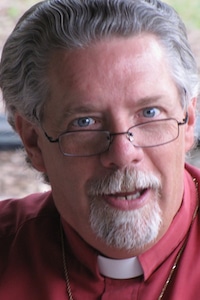
Editor-in-Chief of Whosoever and Founding and Senior Pastor of Gentle Spirit Christian Church of Atlanta, Rev. Paul M. Turner (he/him) grew up in suburban Chicago and was ordained by the Universal Fellowship of Metropolitan Community Churches in 1989. He and his husband Bill have lived in metro Atlanta since 1994, have been in a committed partnership since the early 1980s and have been legally married since 2015.